Ready to onboard?
Are you ready to join DistyParts and
grow your business?


| Distributor | Stock | Pricing | MOQ | PKG | Lead Time | Date Code | On Order Quantity | On Order Delivery | |
|---|---|---|---|---|---|---|---|---|---|
|
1,130 pcs
|
1130 pcs | On Request | 1 | On Request | On Request | On Request | On Request | On Request | |
|
20 pcs
|
20 pcs | On Request | 1 | On Request | On Request | On Request | On Request | On Request | |
|
20 pcs
|
20 pcs | On Request | 1 | On Request | On Request | On Request | On Request | On Request |
| Category | |
| Manufacturer Name | |
| Ambient Temperature | |
| Average Forward Current | |
| Capacitance | |
| Capacitance @ Vr, F | |
| Current | |
| Forward Voltage | |
| Junction Temperature | |
| Mounting Type | |
| Non-repetitive Peak Forward Current | |
| Operating Temperature | |
| Ptot (Maximum @ Tamb ≤ 25 °C, FR 4 PCB 1 cm² cathode pad) | |
| Ptot (Maximum @ Tamb ≤ 25 °C, FR 4 PCB standard footprint) | |
| Ptot (Maximum @ Tamb≤25 °C, ceramic PCB) | |
| Reverse Current | |
| Reverse Voltage | |
| Rth(j-a) (Maximum @ FR 4 PCB, 1 cm² cathode pad) | |
| Rth(j-a) (Maximum @ FR 4 PCB, standard footprint) | |
| Rth(j-a) (Maximum @ ceramic PCB) | |
| Speed | |
| Storage Temperature | |
| Supplier Device Package | |
| Tape & Reel | |
| Technology | |
| Voltage |
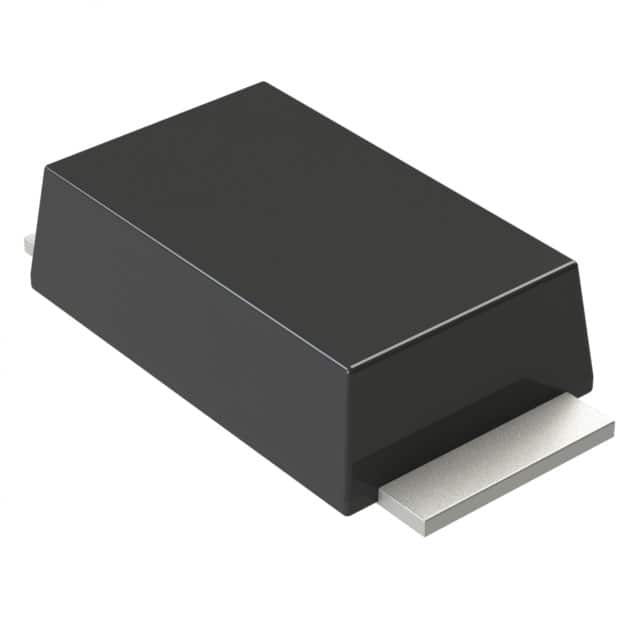
The PMEG4030EP,115 is a 40V, 3A Schottky barrier rectifier from Nexperia, designed for low voltage rectification and high efficiency DC-DC conversion. It features a planar Schottky barrier with an integrated guard ring for stress protection, ensuring reliable operation.
Key electrical specifications include an average forward current of 3 A, reverse voltage of 40 V, and a low forward voltage of typically 430 mV at 3 A. The device offers fast recovery speed (≤500ns) and a non-repetitive peak forward current of 50 A. Power dissipation depends on PCB design: 625 mW on standard FR4, 1.05 W with 1 cm² cathode pad, and 2.1 W on ceramic PCB.
The diode is housed in a SOD128 (CFP5) surface mount package, suitable for reflow and wave soldering. It operates over an ambient temperature range of -55°C to 150°C with a maximum junction temperature of 150°C. Typical applications include low voltage rectification, SMPS, reverse polarity protection, and low power consumption designs.
| Qty | Low | High |
|---|---|---|
| 1+ | $0.88 | $0.88 |
| 10+ | $0.54 | $0.54 |
| 100+ | $0.30 | $0.30 |
| 500+ | $0.25 | $0.25 |
| 1,000+ | $0.23 | $0.23 |
| 3,000+ | $0.18 | $0.18 |
| 6,000+ | $0.16 | $0.16 |
| 9,000+ | $0.14 | $0.14 |
| 24,000+ | $0.14 | $0.14 |
Estimated market price range - modelled values for guidance only, not live distributor offers.
The maximum reverse voltage is 40 V at Tj=25°C.
The average forward current is 3 A under specified conditions (δ=0.5, f=20kHz, square wave, Tsp≤140°C).
The forward voltage is typically 430 mV and maximum 490 mV at IF=3A, Tj=25°C.
The diode is classified as Fast Recovery with ≤500ns, >200mA (Io).
It is available in a SOD128 surface mount package (also known as CFP5).
The operating temperature range is -55°C to 150°C ambient, with a maximum junction temperature of 150°C.
The thermal resistance from junction to ambient (Rth(j-a)) is 200 K/W on standard FR4 PCB, 120 K/W with 1cm² cathode pad, and 60 K/W on ceramic PCB.