

| Distributor | Stock | Pricing | MOQ | PKG | Lead Time | Date Code | On Order Quantity | On Order Delivery | |
|---|---|---|---|---|---|---|---|---|---|
|
13,020 pcs
|
13020 pcs | On Request | 1 | On Request | On Request | On Request | On Request | On Request |
| Category | |
| Manufacturer Name | |
| Current | |
| Latch-up Performance | |
| Logic Type | |
| Mounting Type | |
| Number of Bits per Element | |
| Number of Elements | |
| Operating Temperature | |
| Output Type | |
| Power Dissipation | |
| Supplier Device Package | |
| Voltage |
The 74AVC2T245GUX is a 2-bit dual supply transceiver from Nexperia that enables bidirectional level translation between different voltage nodes. It can be used as two 1-bit transceivers or as a 2-bit transceiver, featuring direction control inputs (DIRn) and an output enable input (OE). The device operates with dual supply voltages VCC(A) and VCC(B) both ranging from 0.8 V to 3.6 V, making it suitable for translating between low voltage nodes such as 0.8 V, 1.2 V, 1.5 V, 1.8 V, 2.5 V, and 3.3 V. Maximum data rates reach 380 Mbit/s for translations from ≥1.8 V to 3.3 V, with lower rates for lower voltage translations. The device features 3-state outputs and incorporates IOFF circuitry for partial power-down applications, preventing backflow current when powered down. It comes in a compact 10-terminal XQFN package (1.4 x 1.8 x 0.5 mm) for surface mount assembly. The part is specified for an operating temperature range of -40°C to 125°C and includes ESD protection of 8 kV HBM and 1 kV CDM.
Both VCC(A) and VCC(B) can be supplied from 0.8 V to 3.6 V.
The maximum data rate is 380 Mbit/s for translation from ≥1.8 V to 3.3 V, with lower rates for other voltage combinations.
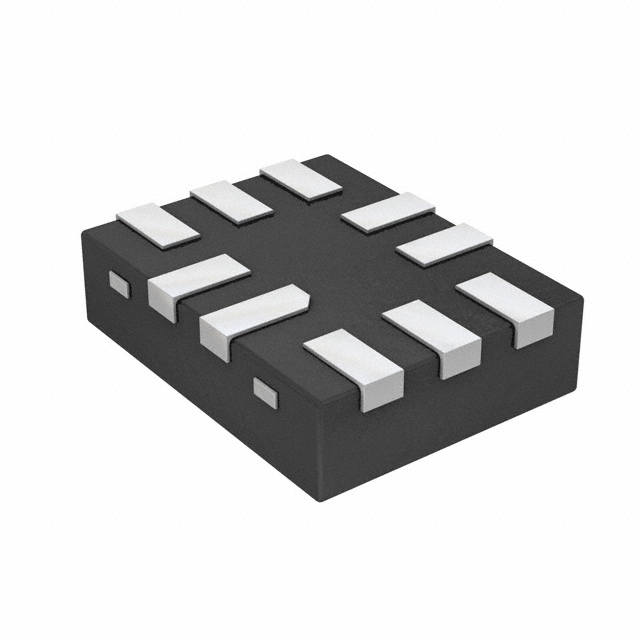
It comes in a 10-terminal XQFN package (SOT1160-1) with body dimensions 1.4 x 1.8 x 0.5 mm for surface mount.
The device operates from -40°C to 125°C.
The manufacturer indicates it is RoHS3 compliant, but this is not verified with documentation.
ESD protection is 8000 V HBM (class 3B) and 1000 V CDM (class C3).
The maximum propagation delay is 13.8 ns, though test conditions are not specified.