

| Distributor | Stock | Pricing | MOQ | PKG | Lead Time | Date Code | On Order Quantity | On Order Delivery | |
|---|---|---|---|---|---|---|---|---|---|
|
6,500 pcs
|
6500 pcs | On Request | 1 | On Request | On Request | On Request | On Request | On Request |
| Category | |
| Manufacturer Name | |
| Current | |
| Input Type | |
| Mounting Type | |
| Operating Temperature | |
| Supplier Device Package | |
| Supplier Package | |
| Supply Voltage | |
| Type |
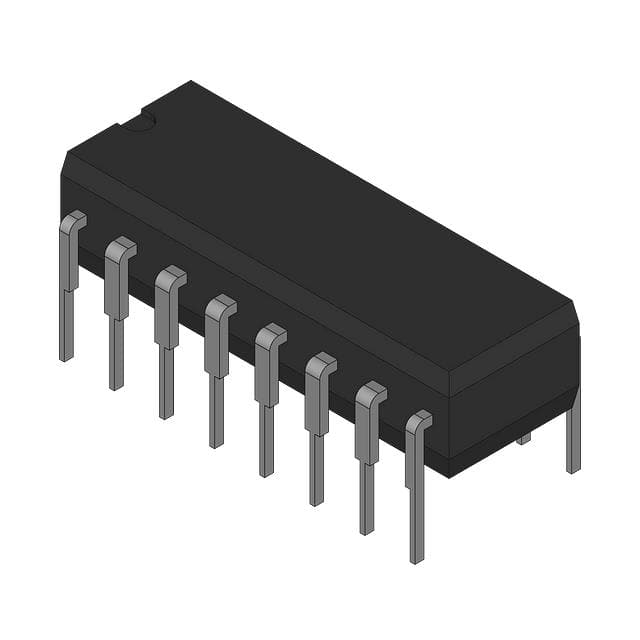
The XTR103AP from Burr-Brown Corporation is a monolithic 4-20mA, two-wire current transmitter specifically designed for Platinum RTD temperature sensors. This integrated circuit provides comprehensive functionality including RTD current excitation, an instrumentation amplifier, linearization circuitry for improved accuracy, and current output circuitry.
Key features include a wide supply voltage range from 9V to 40V and high PSR (110dB min) and CMR (80dB min) ratios. The device offers RTD excitation and linearization, supporting two or three-wire RTD configurations. The total adjusted error for the complete transmitter, including the linearized RTD, is less than ±1% over the operating temperature range of -40°C to +85°C.
This transmitter is suitable for applications in industrial process control, factory automation, and SCADA systems. It is available in a 16-pin PDIP package for through-hole mounting.
The XTR103AP provides a 2nd-order correction to the RTD's nonlinearity, typically achieving a 40:1 improvement in linearity. The instrumentation amplifier gain can be configured for various temperature measurement needs. The device operates on loop power supply voltages down to 9V.
| Qty | Low | High |
|---|---|---|
| 1+ | $2.65 | $2.65 |
Estimated market price range - modelled values for guidance only, not live distributor offers.
The XTR103AP operates over a supply voltage range of 9V to 40V.
The output current range is from 4 mA to 40 mA.
The device operates from -40°C to +85°C.
It comes in a 16-DIP (0.300 inch, 7.62 mm) through-hole package.
It is RoHS3 compliant.