

| Distributor | Stock | Pricing | MOQ | PKG | Lead Time | Date Code | On Order Quantity | On Order Delivery | |
|---|---|---|---|---|---|---|---|---|---|
|
2,002 pcs
|
2002 pcs | On Request | 1 | On Request | On Request | On Request | On Request | On Request | |
|
2,002 pcs
|
2002 pcs | On Request | 1 | On Request | On Request | 24+ | On Request | On Request |
| Category | |
| Manufacturer Name | |
| Lead Style | |
| Operating Voltage |
The Xilinx XC2C64A-7CPG56C is a high-speed, low-power Complex Programmable Logic Device (CPLD) from the CoolRunner-II family. Built on a 0.18 micron CMOS process, this CPLD is optimized for 1.8V systems and supports multi-voltage I/O operation from 1.5V to 3.3V. It offers densities ranging from 32 to 512 macrocells, providing flexibility for various logic synthesis needs.
Key features include fast in-system programming via an IEEE 1532 (JTAG) interface, On-The-Fly Reconfiguration (OTF), and IEEE1149.1 JTAG Boundary Scan Test capabilities. The device incorporates advanced low-power management features like DataGATE and CoolCLOCK technology, along with flexible clocking modes including a clock divider and optional DualEDGE triggered registers. It also supports multiple global clocks with phase selection and global set/reset options.
The XC2C64A-7CPG56C is designed for applications requiring a balance of high speed, low power consumption, and ease of use. Its architecture is optimized for effective logic synthesis, making it suitable for high-speed data communications, computing systems, and portable products. The CPLD also offers advanced design security features and optional I/O pin configurations such as bus-hold, 3-state, or weak pullup.
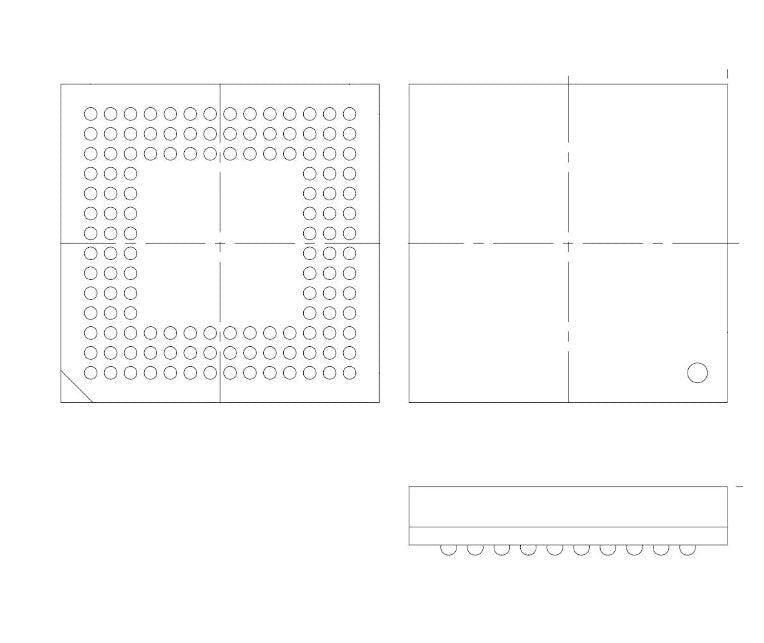
This device comes in a 56-pin package and is designed for surface mounting. Its mixed I/O voltage compatibility ensures seamless integration with various logic levels.
The Xilinx XC2C64A-7CPG56C is optimized for 1.8V systems.
This CPLD supports multi-voltage I/O operation from 1.5V to 3.3V, and is compatible with 1.5V, 1.8V, 2.5V, and 3.3V logic levels.
The device offers densities ranging from 32 to 512 macrocells.
It uses an IEEE 1532 (JTAG) interface for fast in-system programming.
Yes, it supports IEEE1149.1 JTAG Boundary Scan Test.
The clock divider supports ratios of ÷ 2, 4, 6, 8, 10, 12, 14, and 16.