

| Category | |
| Manufacturer Name | |
| Applications | |
| Approval Agency | |
| Current | |
| Efficiency | |
| Features | |
| Height | |
| Input Frequency | |
| Input Voltage | |
| Length | |
| Mounting Type | |
| Number of Outputs | |
| Operating Temperature | |
| Power (Watts) | |
| Relative Humidity | |
| Standard Number | |
| Storage Temperature | |
| Type | |
| Voltage | |
| Width |
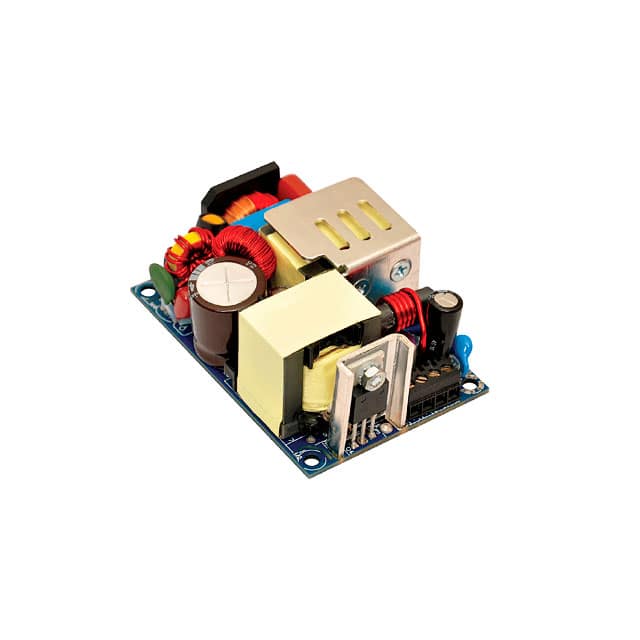
The WLP120-1001-II is an AC-DC converter from EOS Power designed for commercial ITE applications. It delivers a single 12V output at 8.33A, providing 100W under convection cooling and 120W with forced air (300LFM). The converter operates from a universal input range of 85-264 VAC with active power factor correction exceeding 0.95 at full load. Typical efficiency reaches 90% for the 12V output model. Protection features include over current protection at 110% typical, over voltage protection latch type (110-140%), and short circuit hiccup mode. Electrical performance is further characterized by line regulation of ±0.5%, load regulation of ±1%, and transient response recovery within 5 ms.
The converter is rated for operating temperatures from -40°C to 70°C and can withstand storage temperatures from -40°C to 85°C with 5-95% non-condensing humidity. Isolation voltage between input and output is 4000 VDC, meeting ITE safety standards. The unit is chassis-mountable with an open-frame construction and holds safety approvals including CB, CE, cUL, NEMKO, and UL. Its robust design makes it suitable for embedded power systems requiring a reliable and efficient single-output supply.
The input voltage range is 85-264 VAC, universal, with active PFC.
The output is 12V at 8.33A (100W convection, 120W forced air).
The operating temperature range is -40°C to 70°C.
The typical efficiency at 12V and 15V is 90% under full load.
Isolation voltage between input and output is 4000 VDC.
It is a chassis-mountable open-frame converter.
Over current protection at 110% typical, over voltage protection latch type (110-140%), and short circuit protection hiccup mode.