

| Distributor | Stock | Pricing | MOQ | PKG | Lead Time | Date Code | On Order Quantity | On Order Delivery | |
|---|---|---|---|---|---|---|---|---|---|
|
13 pcs
|
13 pcs | On Request | 1 | On Request | On Request | On Request | On Request | On Request |
| Category | |
| Manufacturer Name | |
| Color | |
| Configuration | |
| Current | |
| Height (Max) | |
| Lens Color | |
| Lens Size | |
| Lens Style | |
| Lens Transparency | |
| Millicandela Rating | |
| Mounting Type | |
| Operating Temperature Range | |
| Peak Forward Current | |
| Power Dissipation | |
| Reverse Current | |
| Reverse Voltage | |
| Viewing Angle | |
| Voltage | |
| Wavelength |
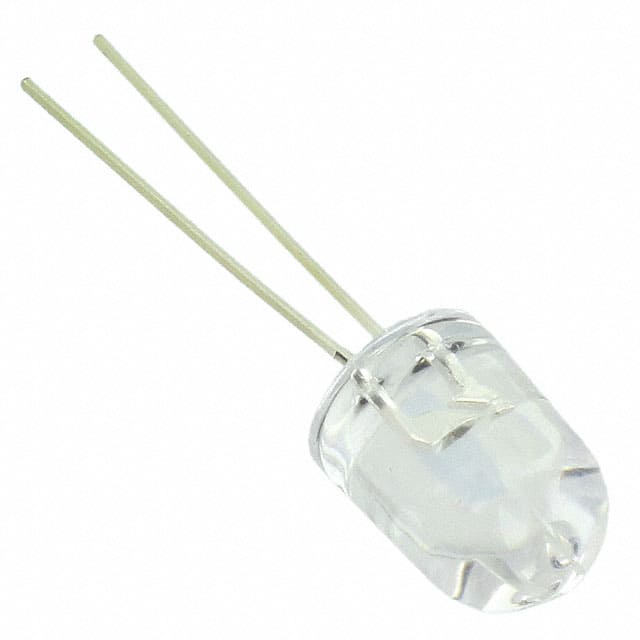
This VAOL-10GAT4 LED from Visual Communications Company is designed for high intensity red light output. It features a clear, water-transparent lens with a domed top and a 10mm diameter.
The LED has a typical forward voltage of 1.8V and a rated forward current of 20mA, with a peak forward current of 85mA. Its luminous intensity is rated at a minimum of 480mcd with a half-intensity angle of 30 degrees. The dominant wavelength is 640nm, and the peak wavelength is 655nm.
Constructed using AlGaAs/GaAs material technology, this component is suitable for applications such as commercial outdoor sign boards, front panel indicators, and dot-matrix modules. It is designed for through-hole mounting and comes in a radial package.
Operating temperature ranges from -40°C to +80°C, and storage temperature ranges from -40°C to +100°C. The maximum power dissipation is 100mW.
| Qty | Low | High |
|---|---|---|
| 1+ | $0.06 | $0.06 |
Estimated market price range - modelled values for guidance only, not live distributor offers.
The typical forward voltage for the VAOL-10GAT4 LED is 1.8V at 20mA.
The minimum luminous intensity of the VAOL-10GAT4 LED is 480mcd at 20mA.
The viewing angle of the VAOL-10GAT4 LED is 30 degrees.
The dominant wavelength of the VAOL-10GAT4 LED is 640nm.
The operating temperature range for the VAOL-10GAT4 LED is -40°C to +80°C.
The VAOL-10GAT4 LED is mounted using the Through Hole method.