

| Distributor | Stock | Pricing | MOQ | PKG | Lead Time | Date Code | On Order Quantity | On Order Delivery | |
|---|---|---|---|---|---|---|---|---|---|
|
178 pcs
|
178 pcs | On Request | 1 | On Request | On Request | 2030+ | On Request | On Request | |
|
5 pcs
|
5 pcs | On Request | 1 | On Request | On Request | On Request | On Request | On Request |
| Category | |
| Manufacturer Name | |
| Current | |
| Mounting Type | |
| Number of Regulators | |
| Operating Temperature | |
| Output Configuration | |
| Output Type | |
| PSRR | |
| Protection Features | |
| SVHC Present | |
| Supplier Device Package | |
| Supplier Package | |
| Voltage | |
| Voltage Dropout (Max) |
The UA7905CKTTR from Texas Instruments is a 3-terminal fixed negative-voltage regulator designed for a wide range of applications. This device can deliver an output current of up to 1.5A. It features internal short-circuit current limiting and thermal-overload protection, making it immune to overload conditions.
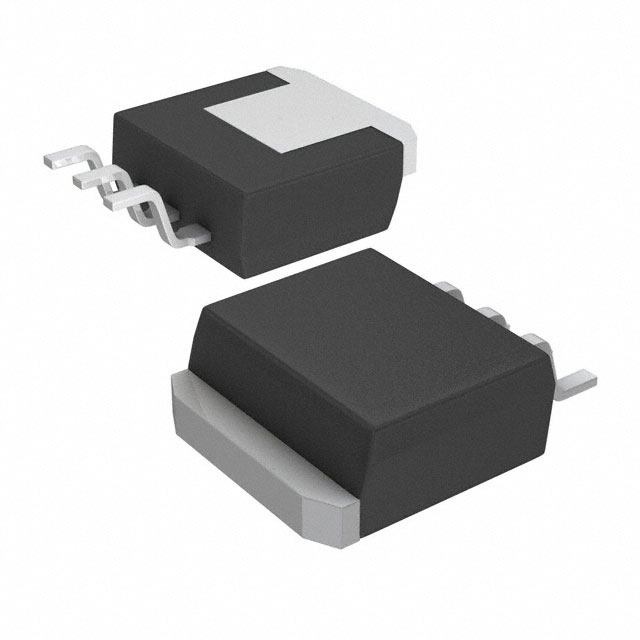
The regulator has a nominal output voltage of -5V and a typical voltage dropout of 1.1V at 1A. It operates within a temperature range of 0°C to 125°C. The device is housed in a surface-mount DDPAK/TO-263-3 package, suitable for various electronic designs.
This series of regulators is designed to complement positive-voltage regulators in applications requiring on-card regulation for noise elimination and distribution problems associated with single-point regulation. It can also be used with external components to obtain adjustable output voltages and currents.
| Qty | Low | High |
|---|---|---|
| 1+ | $0.28 | $0.28 |
Estimated market price range - modelled values for guidance only, not live distributor offers.
The UA7905CKTTR provides a fixed output voltage of -5V.
The maximum output current is 1.5A.
The typical dropout voltage is 1.1V at a 1A load.
The operating junction temperature range is 0°C to 125°C.
It is available in a surface-mount DDPAK/TO-263-3 package (also TO-263-4, D²Pak with 3 leads and tab).
It includes over-current, over-temperature, and short-circuit protection.