

| Distributor | Stock | Pricing | MOQ | PKG | Lead Time | Date Code | On Order Quantity | On Order Delivery | |
|---|---|---|---|---|---|---|---|---|---|
|
2,028 pcs
|
2028 pcs | On Request | 1 | On Request | On Request | 24+ | On Request | On Request | |
|
104 pcs
|
104 pcs | On Request | 1 | On Request | On Request | 17+7 | On Request | On Request |
| Category | |
| Manufacturer Name | |
| Applications | |
| Clock Frequency | |
| Lead Spacing | |
| Mounting Type | |
| Number of Channels | |
| Storage Temperature | |
| Supplier Device Package | |
| Tape & Reel | |
| Type | |
| Voltage |
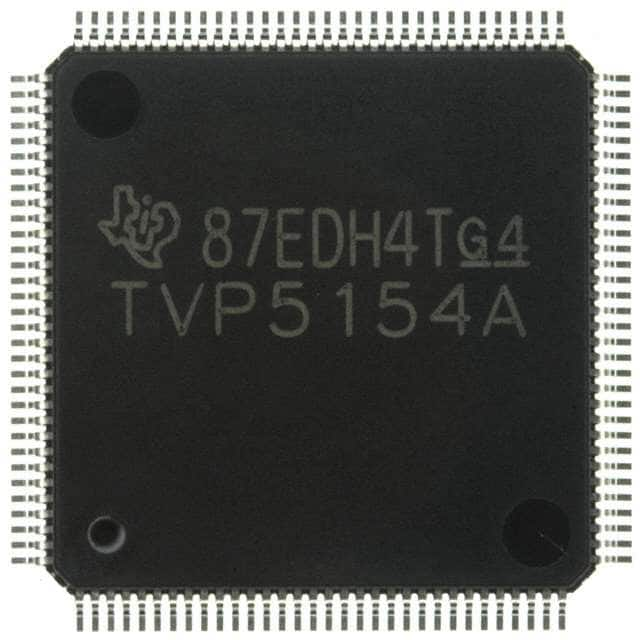
The TVP5154PNPR from Texas Instruments is a versatile 4-channel, low-power video decoder designed for PAL, NTSC, and SECAM video formats. It features independent scalers for each channel, enabling flexible video processing.
Key electrical specifications include a 9-bit Analog-to-Digital Converter (ADC) and an I2C interface for control. The device operates at a typical voltage of 1.8V and consumes approximately 700mW of power. It supports various output formats, including ITU-R BT.656 and 8-bit 4:2:2 with embedded or discrete syncs.
This video decoder is suitable for applications such as security camera systems. It is available in a 128-HTQFP or 128-TQFP Exposed Pad package and uses surface mount technology.
The TVP5154PNPR offers advanced programmable video output and analog preprocessing, including automatic gain control (AGC) and clamping. It supports multiple VBI (Vertical Blanking Interval) modes and features an improved fast lock mode for unstable signals.
| Qty | Low | High |
|---|---|---|
| 1+ | $0.99 | $0.99 |
Estimated market price range - modelled values for guidance only, not live distributor offers.
The TVP5154PNPR supports NTSC (M, 4.43), PAL (B, D, G, H, I, M, N), and SECAM (B, D, G, K, K1, L) video standards.
The operating voltage for the TVP5154PNPR is 1.8V.
The typical power consumption of the TVP5154PNPR is 700mW.
The TVP5154PNPR is available in a 128-HTQFP (14x14) or 128-TQFP Exposed Pad package.
The TVP5154PNPR features a 9-bit Analog-to-Digital Converter (ADC).