
BC847B/215
Nexperia USA Inc.
The Nexperia USA Inc. BC847B/215 is a bipolar transistor. It is RoHS3 Compliant and has an MSL Level 1 rating.


| Distributor | Stock | Pricing | MOQ | PKG | Lead Time | Date Code | On Order Quantity | On Order Delivery | |
|---|---|---|---|---|---|---|---|---|---|
|
9,787 pcs
|
9787 pcs | On Request | 1 | On Request | On Request | 16+ | On Request | On Request | |
|
150 pcs
|
150 pcs | On Request | 1 | On Request | On Request | On Request | On Request | On Request |
| Category | |
| Manufacturer Name | |
| SVHC Present |
The Texas Instruments TLC272ACP is a dual operational amplifier designed for general-purpose applications. It operates over a wide supply voltage range, from 3V to 16V, and supports single-supply operation. The input common-mode voltage range extends below the negative rail, and the output voltage range includes the negative rail.
Key electrical characteristics include a typical Gain Bandwidth Product (GBW) of 2MHz and a slew rate of 3.6V/µs. The offset voltage at 25°C is a maximum of 5mV, with a low offset drift of 1.8µV/°C. It exhibits low noise, typically 25nV/√Hz at 1kHz, and a high input impedance greater than 10¹² Ω. The quiescent current per channel is typically 0.7mA.
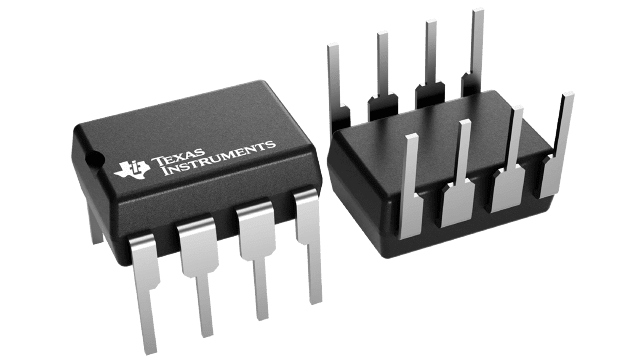
This operational amplifier is available in SOIC and PDIP packages. The SOIC package has an area of 29.4 mm² (4.9 mm × 6 mm), while the PDIP package has an area of 92.5083 mm² (9.81 mm × 9.43 mm). The operating temperature range for catalog applications is -40°C to 85°C.
| Qty | Low | High |
|---|---|---|
| 1+ | $0.79 | $0.79 |
Estimated market price range - modelled values for guidance only, not live distributor offers.
The supply voltage range is 3 V to 16 V for 0°C to 70°C, and 4 V to 16 V for the full temperature range (–40°C to 125°C).
The TLC272ACP is available in SOIC (D) and PDIP (P) packages.
The operating temperature range is –40°C to 85°C.
The typical gain bandwidth product is 2 MHz.
The typical slew rate is 3.6 V/µs.
The input common-mode voltage range extends below the negative rail (rail-to-rail In to V-), but not to the positive rail.
The output voltage range includes the negative rail (down to 0.03 V from negative supply typical).