

| Distributor | Stock | Pricing | MOQ | PKG | Lead Time | Date Code | On Order Quantity | On Order Delivery | |
|---|---|---|---|---|---|---|---|---|---|
|
6,218 pcs
|
6218 pcs | On Request | 1 | On Request | On Request | 1438+ | On Request | On Request |
| Category | |
| Manufacturer Name | |
| Frequency | |
| Full Scale | |
| Linearity | |
| Mounting Type | |
| Power Dissipation | |
| Supplier Device Package | |
| Tape & Reel | |
| Type |
The Microchip Technology TC9400COD is a low-cost, low-power CMOS integrated circuit designed for both Voltage-to-Frequency (V/F) and Frequency-to-Voltage (F/V) conversion applications. It accepts an analog input signal and generates an output pulse train with a frequency linearly proportional to the input voltage, or vice versa for F/V conversion.
Key electrical specifications include a V/F linearity of ±0.05% and an operating frequency range of DC to 100 kHz for both V/F and F/V modes. The device offers a typical power dissipation of 27 mW and can operate from single (+8V to +15V) or dual (±4V to ±7.5V) power supplies. Gain temperature stability is typically ±25 ppm/°C.
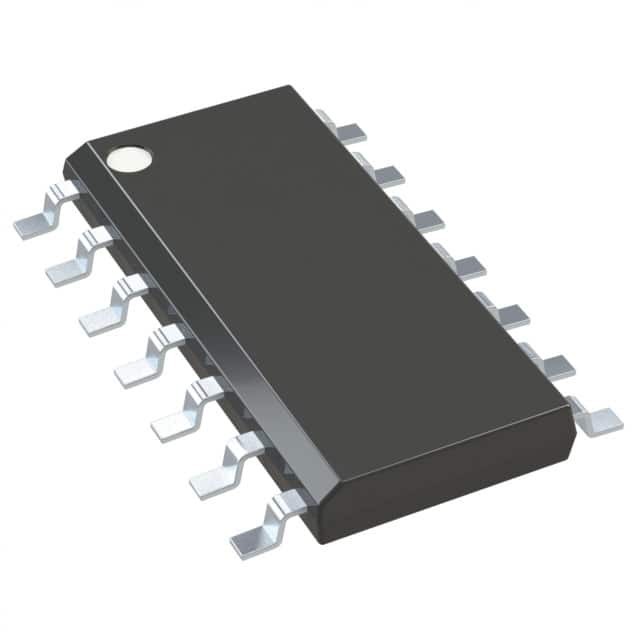
This component is housed in a 14-SOIC package and is designed for surface mounting. A complete V/F or F/V system requires only the addition of external capacitors, resistors, and a reference voltage, making it suitable for various data acquisition and signal processing tasks.
Applications for the TC9400COD include microprocessor data acquisition, analog-to-digital converters, analog data transmission and recording, phase-locked loops, frequency meters, tachometers, motor control, and FM demodulation.
| Qty | Low | High |
|---|---|---|
| 1+ | $0.91 | $0.91 |
Estimated market price range - modelled values for guidance only, not live distributor offers.
The TC9400COD can operate with a single supply of +8V to +15V or dual supplies of ±4V to ±7.5V.
The TC9400COD is available in a 14-SOIC (0.154", 3.90mm Width) surface-mount package.
The TC9400COD operates at a nominal frequency of 100 kHz for both V/F and F/V conversion.
The typical V/F conversion linearity is ±0.05%.
The typical F/V conversion linearity is ±0.02%.
The typical gain temperature stability is ±25 ppm/°C.
The typical power dissipation is 27 mW.