

| Distributor | Stock | Pricing | MOQ | PKG | Lead Time | Date Code | On Order Quantity | On Order Delivery | |
|---|---|---|---|---|---|---|---|---|---|
|
5,200 pcs
|
5200 pcs | On Request | 1 | On Request | On Request | 09+/10/11+NOPB | On Request | On Request | |
|
1,602 pcs
|
1602 pcs | On Request | 1 | On Request | On Request | On Request | On Request | On Request |
| Category | |
| Manufacturer Name | |
| Current | |
| Drain to Source Voltage (Vdss) | |
| Drive Voltage (Max Rds On, Min Rds On) | |
| FET Type | |
| Gate Charge (Qg) (Max) @ Vgs | |
| Input Capacitance (Ciss) (Max) @ Vds | |
| Mounting Type | |
| Operating Temperature | |
| Power Dissipation (Max) | |
| Rds On (Max) @ Id, Vgs | |
| Supplier Device Package | |
| Technology | |
| Vgs (Max) | |
| Vgs(th) (Max) @ Id |
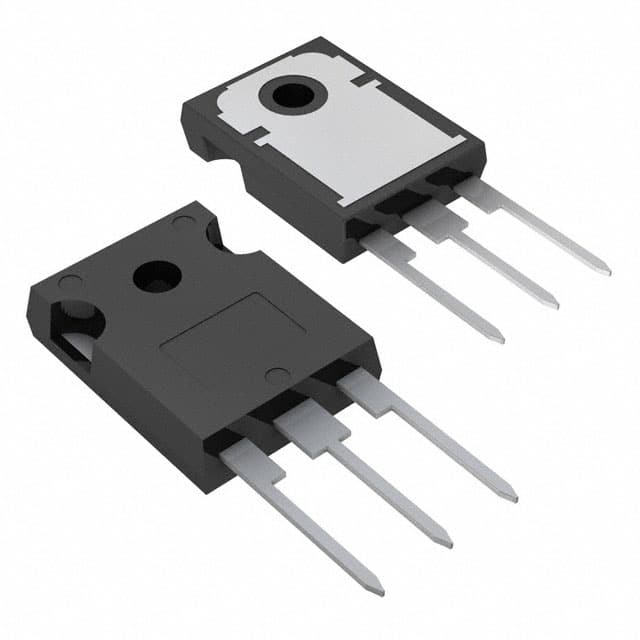
The STMicroelectronics STW7N95K3 is a high-voltage N-Channel MOSFET designed for power switching applications. It offers a maximum drain-source voltage (Vdss) of 950V and a continuous drain current (Id) of 7.2A at case temperature.
Key electrical characteristics include a maximum on-resistance (Rds On) of 1.35 Ohms at 3.6A and 10V gate-source voltage, and a gate threshold voltage (Vgs(th)) of 5V at 100µA. The device has a maximum gate-to-source voltage (Vgs) of ±30V and features a gate charge (Qg) of 34 nC at 10V.
This MOSFET is housed in a TO-247-3 package, suitable for through-hole mounting. It operates within a temperature range of -55°C to 150°C (TJ) and has a maximum power dissipation of 150W (Tc).
The technology employed is MOSFET (Metal Oxide), providing efficient switching capabilities for various power electronics designs.
| Qty | Low | High |
|---|---|---|
| 1+ | $2.56 | $2.56 |
Estimated market price range - modelled values for guidance only, not live distributor offers.
The maximum drain-source voltage (Vdss) is 950V.
The continuous drain current is 7.2A (Tc).
The maximum on-resistance (Rds On) is 1.35 Ohms at 3.6A and 10V.
The operating temperature range is -55°C to 150°C (TJ).
It is in a TO-247-3 package.
It is mounted using the through-hole method.