

| Distributor | Stock | Pricing | MOQ | PKG | Lead Time | Date Code | On Order Quantity | On Order Delivery | |
|---|---|---|---|---|---|---|---|---|---|
|
90,400 pcs
|
90400 pcs | On Request | 1 | On Request | On Request | On Request | On Request | On Request |
| Category | |
| Manufacturer Name | |
| Current | |
| ESD Protection | |
| Input Voltage | |
| Latch-up Performance | |
| Logic Type | |
| Mounting Type | |
| Number of Bits per Element | |
| Number of Channels | |
| Number of Elements | |
| Operating Temperature | |
| Operating Voltage | |
| Output Type | |
| Propagation Delay | |
| SVHC Present | |
| Supplier Device Package | |
| Supplier Package | |
| Tape & Reel | |
| Voltage |
The SN74LVC827ADBR from Texas Instruments is a 10-bit buffer and bus driver designed for 1.65-V to 3.6-V VCC operation. This device features 3-state outputs and is suitable for mixed-mode signal applications, accepting input voltages up to 5.5V while operating at a 3.3V VCC. It offers a maximum propagation delay of 6.7 ns at 3.3V.
Key electrical characteristics include typical output ground bounce of less than 0.8V and typical output VOH undershoot greater than 2V at 3.3V and 25°C. The device supports live insertion, partial power-down mode, and back-drive protection, with latch-up performance exceeding 250 mA per JESD 17. ESD protection exceeds JESD 22 standards, including 2000V for the human-body model, 200V for the machine model, and 1000V for the charged-device model.
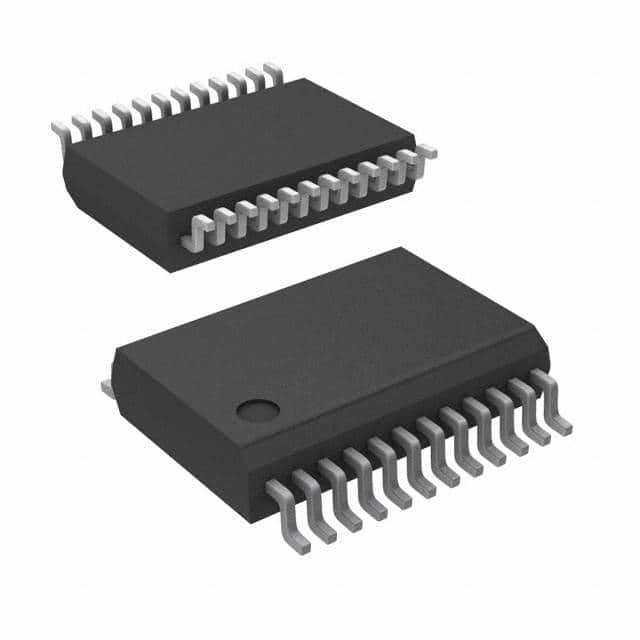
Packaged in a 24-SSOP, the SN74LVC827ADBR is designed for surface mounting. It operates within an ambient temperature range of -40°C to 125°C. The standard package quantity is 2,000 units on a tape and reel.
| Qty | Low | High |
|---|---|---|
| 1+ | $0.64 | $0.64 |
Estimated market price range - modelled values for guidance only, not live distributor offers.
The SN74LVC827ADBR operates from 1.65V to 3.6V.
The operating temperature range is -40°C to 125°C.
It is available in a 24-pin SSOP surface-mount package.
The device can sink and source 24 mA.
The maximum propagation delay is 6.7 ns at 3.3V.
Yes, it includes ESD protection exceeding JESD 22: 2000V human-body model, 200V machine model, and 1000V charged-device model.