

| Distributor | Stock | Pricing | MOQ | PKG | Lead Time | Date Code | On Order Quantity | On Order Delivery | |
|---|---|---|---|---|---|---|---|---|---|
|
1,042 pcs
|
1042 pcs | On Request | 1 | On Request | On Request | On Request | On Request | On Request |
| Category | |
| Manufacturer Name | |
| Current | |
| Features | |
| Input Type | |
| Latch-up Performance | |
| Lead Spacing | |
| Logic Type | |
| Mounting Type | |
| Number of Bits per Element | |
| Number of Elements | |
| Operating Temperature | |
| Output Type | |
| Propagation Delay | |
| Supplier Device Package | |
| Supply Current | |
| Supply Voltage | |
| Voltage |
The SN74LVC1G34DCKR from Texas Instruments is a single buffer gate that performs the Boolean function Y = A in positive logic. It operates over a wide supply voltage range of 1.65V to 5.5V, accepting input voltages up to 5.5V and providing down translation to VCC. This CMOS device offers a high output drive of ±24mA at 3.3V while maintaining low static power consumption, with a maximum supply current of 1µA.
Key features include balanced outputs, over-voltage tolerant inputs, and partial power-down capability (Ioff), which supports live insertion and back-drive protection. The device exhibits very high speed with a maximum propagation delay of 3.5ns at 3.3V. Latch-up performance exceeds 100mA per JESD 78, Class II, and ESD protection is robust, meeting JESD 22 standards.
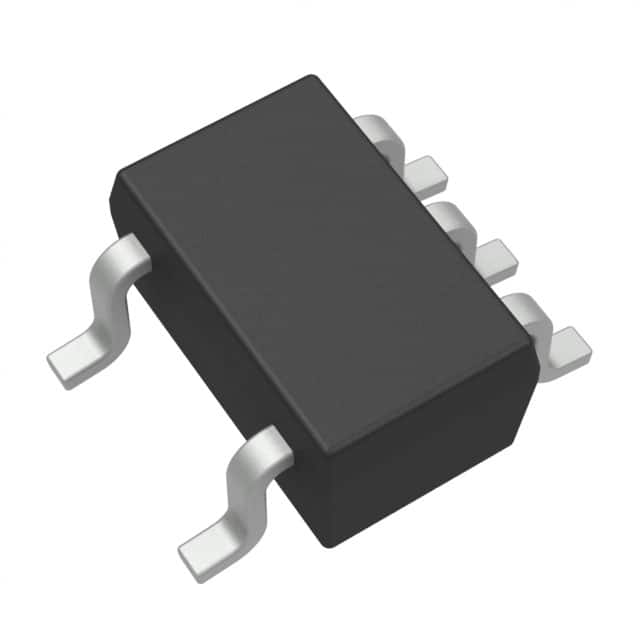
Packaged in a surface-mount SC-70-5 (5-TSSOP, SOT-353) configuration, the SN74LVC1G34DCKR is suitable for applications requiring efficient buffering and signal integrity. Its operating temperature range is -40°C to 125°C (TA).
| Qty | Low | High |
|---|---|---|
| 1+ | $0.09 | $0.09 |
Estimated market price range - modelled values for guidance only, not live distributor offers.
The SN74LVC1G34DCKR operates from 1.65V to 5.5V.
The SN74LVC1G34DCKR is available in an SC-70-5 package.
The operating temperature range is -40°C to 125°C (TA).
The SN74LVC1G34DCKR is RoHS3 Compliant.
The output drive current is ±24mA at 3.3V.
The maximum propagation delay is 3.5ns at 3.3V.