

| Distributor | Stock | Pricing | MOQ | PKG | Lead Time | Date Code | On Order Quantity | On Order Delivery | |
|---|---|---|---|---|---|---|---|---|---|
|
6 pcs
|
6 pcs | On Request | 1 | On Request | On Request | On Request | On Request | On Request |
| Category | |
| Manufacturer Name | |
| Architecture | |
| ESD Protection | |
| Logic Type | |
| Mounting Type | |
| Number of Bits | |
| Operating Temperature | |
| Package Quantity | |
| Supplier Device Package | |
| Supply Voltage |
The Texas Instruments SN74LVC161284DLR is a 19-bit bus interface transceiver featuring 3-state outputs, designed for efficient asynchronous two-way communication between data buses. It operates with a VCC range of 3V to 3.6V and is specified for an operating temperature range of 0°C to 70°C.
This device integrates eight bidirectional bits for data flow control, along with five drivers and four receivers. A key feature is the integrated pull-up resistors on all open-drain outputs, eliminating the need for discrete components. The transceiver also offers robust ESD protection, exceeding 2000V per MIL-STD-883.
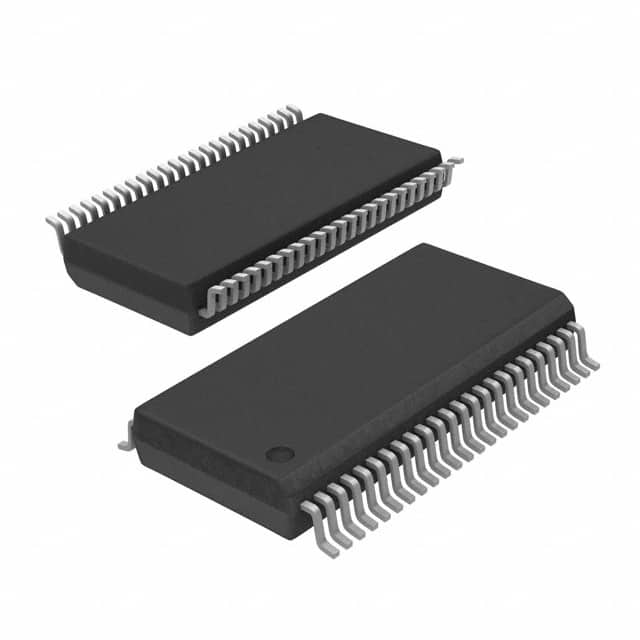
Designed to meet IEEE Std 1284-I and IEEE Std 1284-II electrical specifications, the SN74LVC161284DLR utilizes a flow-through architecture to optimize PCB layout. It is available in a 48-pin SSOP package, suitable for surface mounting.
This transceiver is ideal for applications requiring reliable data bus communication and level translation within the specified voltage and temperature parameters. Its design considerations include minimizing external timing requirements and optimizing board space.
| Qty | Low | High |
|---|---|---|
| 1+ | $1.38 | $1.38 |
Estimated market price range - modelled values for guidance only, not live distributor offers.
The logic type is IEEE STD 1284 Translation Transceiver.
It handles 19 bits.
The supply voltage range is 3V to 3.6V.
The operating temperature range is 0°C to 70°C.
It comes in a 48-SSOP package (48-BSSOP, 0.295\" width, 7.50mm width).
Yes, pullup resistors are integrated on all open-drain outputs.
It exceeds 2000V per MIL-STD-883 Method 3015 and exceeds 200V using the machine model (C = 200 pF, R = 0).