

| Distributor | Stock | Pricing | MOQ | PKG | Lead Time | Date Code | On Order Quantity | On Order Delivery | |
|---|---|---|---|---|---|---|---|---|---|
|
3,600 pcs
|
3600 pcs | On Request | 1 | On Request | On Request | On Request | On Request | On Request | |
|
1,000 pcs
|
1000 pcs | On Request | 1 | On Request | On Request | On Request | On Request | On Request | |
|
500 pcs
|
500 pcs | On Request | 1 | On Request | On Request | On Request | On Request | On Request | |
|
16 pcs
|
16 pcs | On Request | 15 | On Request | On Request | On Request | On Request | On Request |
| Category | |
| Manufacturer Name | |
| Clock Frequency | |
| Current | |
| Function | |
| Input Capacitance | |
| Lead Spacing | |
| Lead Style | |
| Max Propagation Delay @ V, Max CL | |
| Mounting Type | |
| Number of Bits per Element | |
| Number of Elements | |
| Operating Temperature | |
| Output Type | |
| SVHC Present | |
| Supplier Device Package | |
| Tape & Reel | |
| Trigger Type | |
| Type | |
| Voltage |
The SN74HC174N from Texas Instruments is a Hex D-Type Flip-Flop featuring six flip-flops with shared clock and clear inputs. It operates with a wide voltage range from 2V to 6V and supports a clock frequency of up to 50 MHz. This device is designed for applications such as buffer/storage registers, shift registers, and pattern generators.
The SN74HC174N has a typical propagation delay of 14 ns and can drive up to 10 LSTTL loads. Its outputs provide ±4-mA drive at 5V. The component consumes low power, with a maximum ICC of 80 μA and a low input current of 1 μA.
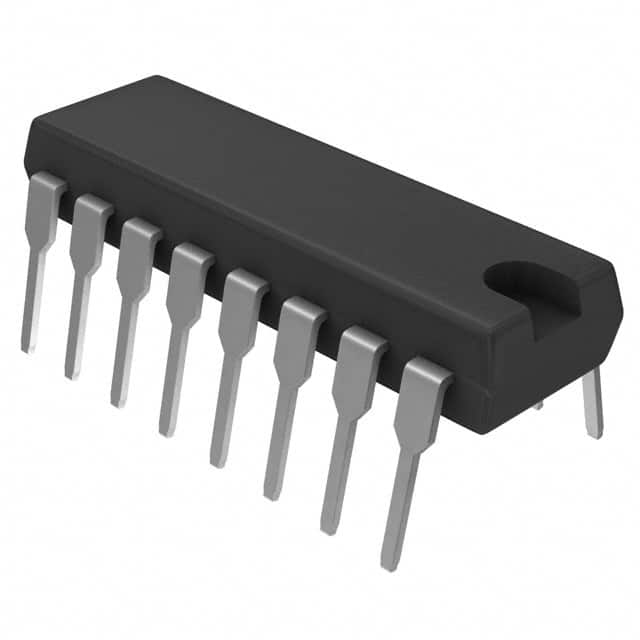
Packaged in a 16-PDIP through-hole configuration, the SN74HC174N is suitable for various electronic designs. It operates within an ambient temperature range of -40°C to 85°C.
| Qty | Low | High |
|---|---|---|
| 1+ | $0.86 | $0.86 |
Estimated market price range - modelled values for guidance only, not live distributor offers.
The operating voltage range is 2V to 6V.
The maximum clock frequency is 50 MHz.
The package type is 16-PDIP.
The operating temperature range is -40°C to 85°C.
The typical propagation delay is 14 ns.