

| Distributor | Stock | Pricing | MOQ | PKG | Lead Time | Date Code | On Order Quantity | On Order Delivery | |
|---|---|---|---|---|---|---|---|---|---|
|
200,000 pcs
|
200000 pcs | On Request | 1 | On Request | On Request | On Request | On Request | On Request |
| Category | |
| Manufacturer Name | |
| Channel | |
| Channel Capacitance (CS(off), CD(off)) | |
| Crosstalk | |
| Current | |
| Frequency | |
| Latch-up Performance | |
| Lead Spacing | |
| Mounting Type | |
| Multiplexer | |
| Number of Circuits | |
| On | |
| Operating Temperature | |
| Supplier Device Package | |
| Switch Circuit | |
| Switch Time (Ton, Toff) (Max) | |
| Tape & Reel | |
| Voltage |
The SN74AUC2G53YZPR from Texas Instruments is a single-channel, 2:1 analog switch designed for signal gating, multiplexing, and other signal routing applications. It supports analog and digital signals and operates over a wide voltage range from 0.8V to 2.7V, with specific design focus for 1.1V to 2.7V VCC operation.
This device offers a low on-resistance of 15 Ohms and a bandwidth of 50MHz, making it suitable for various signal processing tasks. It also provides high linearity and excellent ESD protection exceeding 2000V (HBM). The switch features fast switching times of 2.2ns (Ton) and 2.3ns (Toff).
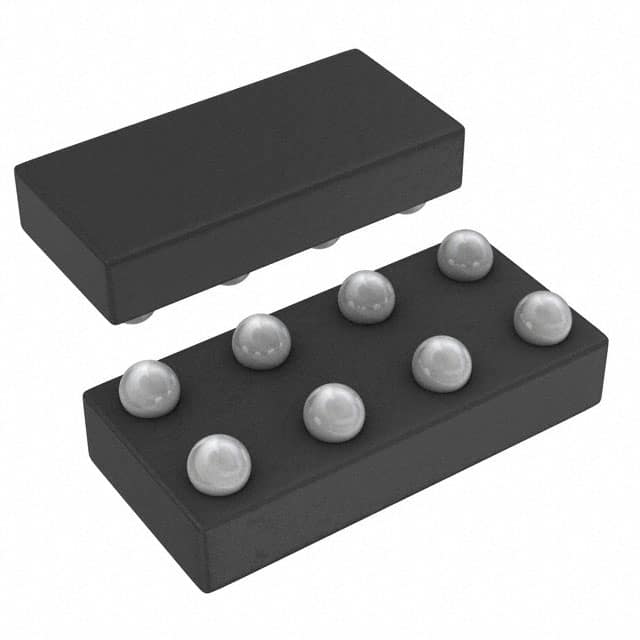
Packaged in an 8-pin DSBGA (YZP) format, the SN74AUC2G53YZPR is designed for surface mounting. It operates within an ambient temperature range of -40°C to 85°C. The NanoFree package technology utilizes the die as the package, enabling a smaller footprint.
Applications include signal multiplexing for analog-to-digital and digital-to-analog conversion systems, signal gating, chopping, and modulation/demodulation.
| Qty | Low | High |
|---|---|---|
| 1+ | $0.32 | $0.32 |
Estimated market price range - modelled values for guidance only, not live distributor offers.
The operating voltage range is 0.8V to 2.7V.
It comes in an 8-DSBGA package.
The maximum on-resistance is 15 Ohms.
The switch time is approximately 2.2ns to 2.3ns.
It operates at up to 50MHz.
It exceeds 2000V for Human-Body Model and 200V for Machine Model.