

| Distributor | Stock | Pricing | MOQ | PKG | Lead Time | Date Code | On Order Quantity | On Order Delivery | |
|---|---|---|---|---|---|---|---|---|---|
|
361,600 pcs
|
361600 pcs | On Request | 1 | On Request | On Request | On Request | On Request | On Request |
| Category | |
| Manufacturer Name | |
| Current | |
| Input Type | |
| Latch-up Performance | |
| Logic Type | |
| Mounting Type | |
| Number of Bits per Element | |
| Number of Elements | |
| Operating Temperature | |
| Output Type | |
| Supplier Device Package | |
| Supplier Package | |
| Voltage |
The Texas Instruments SN74AUC1G17DRLR is a single Schmitt-Trigger buffer designed for low-voltage applications. It operates across a wide voltage range from 0.8V to 2.7V, making it suitable for mixed-mode signal operation. This buffer performs the Boolean function Y = A and utilizes Schmitt action for its input threshold levels.
Key electrical characteristics include a maximum propagation delay (tpd) of 2.4 ns at 1.8V and an output drive of ±8 mA at 1.8V. It also features low power consumption with a maximum supply current of 10 µA. The device is specified for partial power-down applications using Ioff, which prevents damaging current backflow.
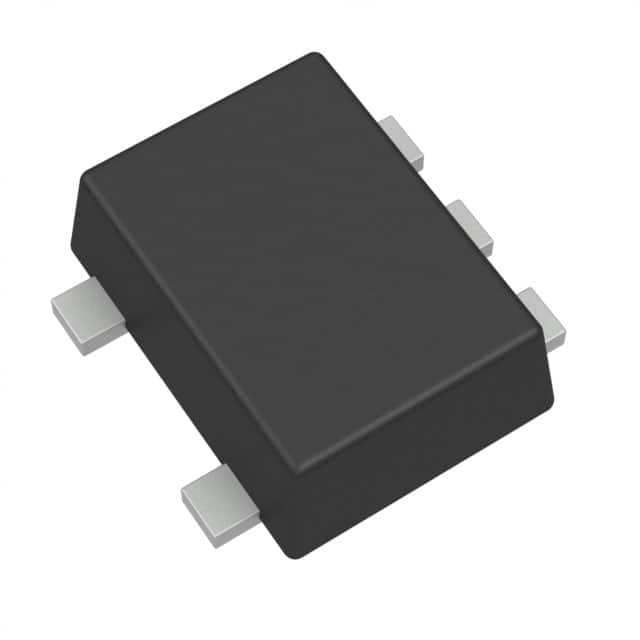
This component is available in the SOT-553 package, designed for surface mounting. It operates within an ambient temperature range of -40°C to 85°C. The SN74AUC1G17DRLR also offers robust protection features, including latch-up performance exceeding 100 mA per JESD 78, Class II, and ESD protection exceeding 2000V (HBM), 200V (MM), and 1000V (CDM).
Applications for this buffer include AV receivers, portable audio devices, embedded PCs, solid-state drives, and wireless peripherals.
| Qty | Low | High |
|---|---|---|
| 1+ | $0.12 | $0.12 |
Estimated market price range - modelled values for guidance only, not live distributor offers.
0.8V to 2.7V.
SOT-553 (also referred to as SOT-5).
-40°C to 85°C.
±8 mA at 1.8V.
2.4 ns at 1.8V (maximum).
2000V Human-Body Model, 200V Machine Model, 1000V Charged-Device Model.
Buffer, Non-Inverting with Schmitt-trigger input.