

| Distributor | Stock | Pricing | MOQ | PKG | Lead Time | Date Code | On Order Quantity | On Order Delivery | |
|---|---|---|---|---|---|---|---|---|---|
|
332 pcs
|
332 pcs | On Request | 1 | On Request | On Request | 414 | On Request | On Request | |
|
70 pcs
|
70 pcs | On Request | 1 | On Request | On Request | On Request | On Request | On Request |
| Category | |
| Manufacturer Name | |
| Current | |
| Latch-up Performance | |
| Logic Type | |
| Mounting Type | |
| Number of Bits per Element | |
| Number of Elements | |
| Operating Temperature | |
| Output Type | |
| Supplier Device Package | |
| Tape & Reel | |
| Voltage | |
| Voltage Supply |
The SN74ALVC244PW from Texas Instruments is an octal buffer/line driver designed for 1.65V to 3.6V VCC operation. This device is organized as two 4-bit line drivers, each with a separate output-enable (OE) input. When OE is low, data passes from the A inputs to the Y outputs. When OE is high, the outputs enter a high-impedance state.
Key electrical specifications include an operating voltage range of 1.65V to 3.6V and an output drive capability of ±24mA at 3.3V. The maximum propagation delay is 2.8ns at 3.3V. It also features robust ESD protection, exceeding 2000V for the Human-Body Model.
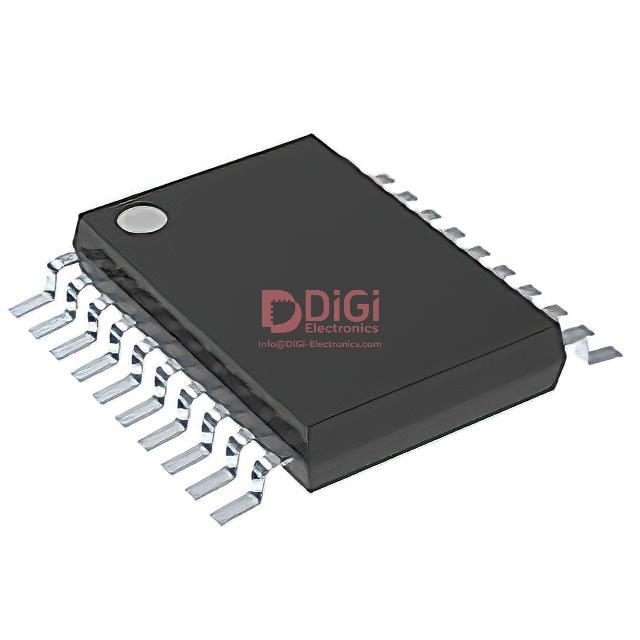
This buffer/driver is housed in a 20-TSSOP package, suitable for surface mounting. It operates across a temperature range of -40°C to 85°C, making it suitable for various industrial applications. The 3-state output capability is crucial for bus-oriented systems where outputs need to be disabled to prevent bus contention.
| Qty | Low | High |
|---|---|---|
| 1+ | $1.20 | $1.20 |
Estimated market price range - modelled values for guidance only, not live distributor offers.
The SN74ALVC244PW operates from 1.65V to 3.6V.
The SN74ALVC244PW has an output current capability of 24mA for both high and low states.
The operating temperature range is -40°C to 85°C (TA).
The SN74ALVC244PW is available in a 20-TSSOP package.
The logic type is Buffer, Non-Inverting.
It has 2 elements, with 4 bits per element.
The maximum propagation delay is 2.8 ns at 3.3V.