

| Distributor | Stock | Pricing | MOQ | PKG | Lead Time | Date Code | On Order Quantity | On Order Delivery | |
|---|---|---|---|---|---|---|---|---|---|
|
3,500 pcs
|
3500 pcs | On Request | 1 | On Request | On Request | On Request | On Request | On Request |
| Category | |
| Manufacturer Name | |
| Current | |
| Latch-up Performance | |
| Lead Style | |
| Logic Type | |
| Mounting Type | |
| Number of Bits per Element | |
| Number of Elements | |
| Operating Temperature | |
| Operating Voltage | |
| Output Current | |
| Output Type | |
| Propagation Delay | |
| SVHC Present | |
| Supplier Device Package | |
| Supplier Package | |
| Supply Current | |
| Voltage |
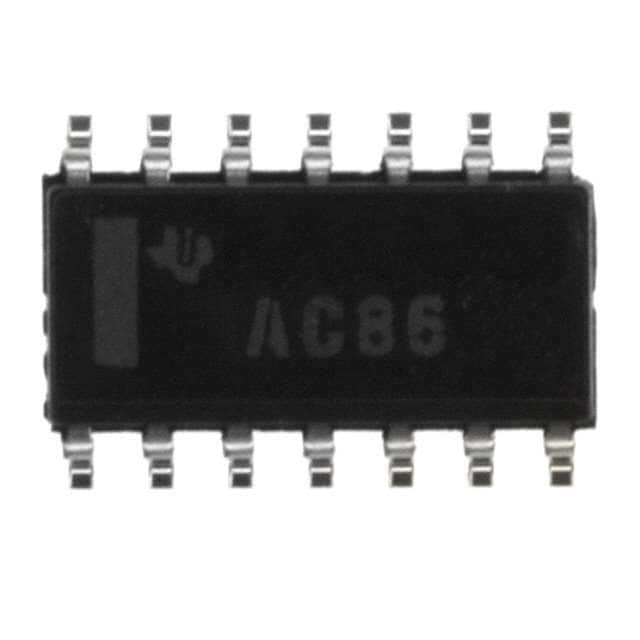
The SN74AHC126DBR is a quadruple bus buffer gate IC manufactured by Texas Instruments. It features independent line drivers with 3-state outputs, suitable for bus buffering applications. Each gate passes data from its A input to its Y output when the output-enable (OE) input is high, and is disabled when OE is low, entering a high-impedance state.
This device operates within a supply voltage range of 2V to 5.5V and functions across an ambient temperature range of -40°C to 85°C. It offers a typical propagation delay of 3.8 ns with a 5V supply and has a latch-up performance exceeding 250 mA per JESD 17. The SN74AHC126DBR is supplied in a 14-SSOP package, designed for surface mounting.
Key electrical characteristics include a maximum supply current of 40 µA and output currents of 8mA (IOL) and -8mA (IOH). The logic type is a non-inverting buffer, with 4 elements each handling 1 bit. This component is ideal for applications requiring efficient bus buffering and signal control in digital systems.
| Qty | Low | High |
|---|---|---|
| 1+ | $0.13 | $0.13 |
Estimated market price range - modelled values for guidance only, not live distributor offers.
The SN74AHC126DBR operates from 2V to 5.5V.
The operating temperature range is -40°C to 85°C.
The typical propagation delay is 3.8 ns with a 5-V supply.
The SN74AHC126DBR is offered in a 14-SSOP surface-mount package.
The outputs are 3-state.
The device contains 4 buffer elements, each with 1 bit per element.