

| Distributor | Stock | Pricing | MOQ | PKG | Lead Time | Date Code | On Order Quantity | On Order Delivery | |
|---|---|---|---|---|---|---|---|---|---|
|
69,538 pcs
|
69538 pcs | On Request | 1 | On Request | On Request | On Request | On Request | On Request | |
|
1,472 pcs
|
1472 pcs | On Request | 1 | On Request | On Request | On Request | On Request | On Request | |
|
26 pcs
|
26 pcs | On Request | 1 | On Request | On Request | On Request | On Request | On Request |
| Category | |
| Manufacturer Name | |
| Duplex | |
| Supply Voltage |
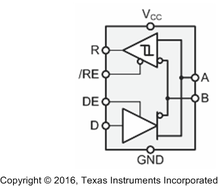
The SN65HVD12D from Texas Instruments is a 3.3V differential transceiver designed for RS-485 and RS-422 communication. This half-duplex device integrates a 3-state differential line driver and a differential input line receiver, operating from a single 3.3V power supply.
Key electrical specifications include a maximum signaling rate of 1 Mbps, with optional transition times supporting up to 32 Mbps. It offers a wide fault protection range of -9V to 14V and a common-mode voltage range of -7V to 12V. The transceiver supports up to 256 nodes on the bus, making it suitable for multi-drop networks.
Designed for robust operation, the SN65HVD12D features bus-pin ESD protection exceeding 16-kV HBM, bus-pin short-circuit protection from -7V to 12V, and thermal shutdown protection. It also includes glitch-free power-up and power-down protection for hot-plugging applications and open-circuit, idle-bus, and shorted-bus fail-safe receiver functionality.
Available in SOIC and PDIP packages, the SN65HVD12D operates within a temperature range of -40°C to 85°C. Its low-current standby mode consumes only 1 µA typical, contributing to power efficiency in embedded systems.
| Qty | Low | High |
|---|---|---|
| 1+ | $2.50 | $2.50 |
Estimated market price range - modelled values for guidance only, not live distributor offers.
The SN65HVD12D operates with a 3.3V supply.
The SN65HVD12D operates in half-duplex mode.
The SN65HVD12D supports up to 256 nodes on the bus.
The operating temperature range is -40°C to 85°C.
The maximum signaling rate is 1 Mbps.
The bus-pin ESD protection exceeds 16-kV HBM.
The low-current standby mode is 1 µA, typical.