

| Distributor | Stock | Pricing | MOQ | PKG | Lead Time | Date Code | On Order Quantity | On Order Delivery | |
|---|---|---|---|---|---|---|---|---|---|
|
1,500 pcs
|
1500 pcs | On Request | 1 | On Request | On Request | On Request | On Request | On Request |
| Category | |
| Manufacturer Name | |
| Differential | |
| Divider | |
| Frequency | |
| Input | |
| Mounting Type | |
| Number of Circuits | |
| Operating Temperature | |
| Output | |
| PLL | |
| Ratio | |
| Supplier Device Package | |
| Tape & Reel | |
| Type | |
| Voltage |
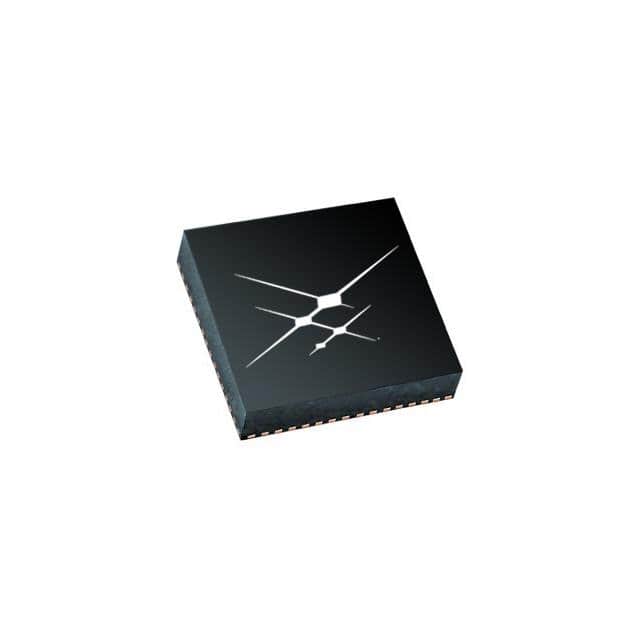
The Skyworks Solutions SI5395M-A-GMR is a 12-channel jitter attenuator and clock multiplier utilizing DSPLL and Multi-Synth technologies. It is designed for high-performance applications requiring ultra-low jitter, such as 56G SerDes clocking.
Key electrical specifications include an input frequency range of 8 kHz to 750 MHz (Differential) and 8 kHz to 250 MHz (LVCMOS), with output frequencies ranging from 100 Hz to 1028 MHz (Differential) and 100 Hz to 250 MHz (LVCMOS). It supports multiple output types including CML, HCSL, LVDS, LVPECL, and LVCMOS. The device operates across two voltage rails: 1.71V to 1.89V and 3.14V to 3.47V.
This jitter attenuator features integrated PLL functionality and a 4:12 input to output ratio. It operates within a temperature range of -40°C to 85°C. The device is available in a 64-LGA (9x9) package and is designed for surface mount.
Applications for the SI5395M-A-GMR include 56G/112G PAM4 SerDes clocking, OTN muxponders and transponders, and 10/40/100/200/400G networking line cards.
| Qty | Low | High |
|---|---|---|
| 1+ | $7.01 | $7.01 |
Estimated market price range - modelled values for guidance only, not live distributor offers.
The operating voltage is 1.71V to 1.89V and 3.14V to 3.47V.
The operating temperature range is -40°C to 85°C.
It is available in a 64-TFLGA Exposed Pad package.
It supports CML, HCSL, LVDS, LVPECL, and LVCMOS output types.
The ultra-low phase jitter is 69 fs RMS for Grade P, 71 fs RMS for Grade E, 85 fs RMS in integer mode, and 100 fs RMS in fractional mode.
The input frequency range is 8 kHz to 750 MHz for differential signals and 8 kHz to 250 MHz for LVCMOS signals.
The output frequency range is 100 Hz to 1028 MHz for differential signals and 100 Hz to 250 MHz for LVCMOS signals.