

| Distributor | Stock | Pricing | MOQ | PKG | Lead Time | Date Code | On Order Quantity | On Order Delivery | |
|---|---|---|---|---|---|---|---|---|---|
|
356 pcs
|
356 pcs | On Request | 1 | On Request | On Request | On Request | On Request | On Request | |
|
356 pcs
|
356 pcs | On Request | 1 | On Request | On Request | On Request | On Request | On Request |
| Category | |
| Manufacturer Name | |
| Base Resonator | |
| Current | |
| Frequency | |
| Frequency Stability | |
| Function | |
| Height | |
| Lead Spacing | |
| Lead Style | |
| Length | |
| Mounting Type | |
| Operating Temperature | |
| Output | |
| Storage Temperature | |
| Type | |
| Voltage | |
| Width |
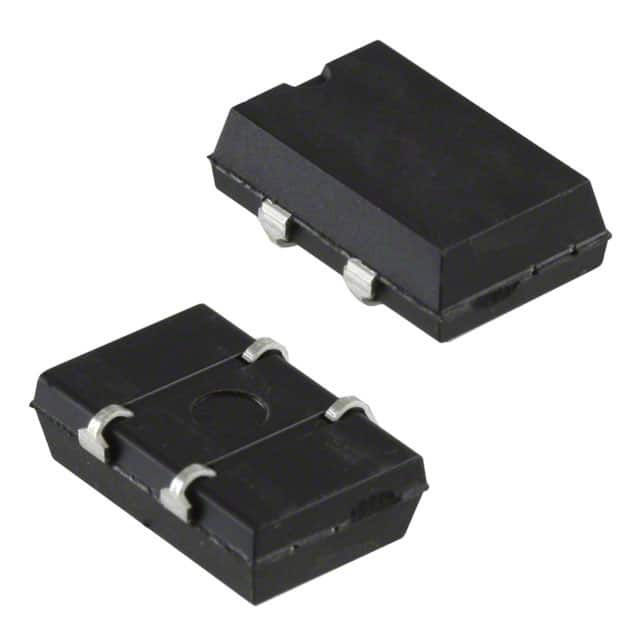
The Epson SG-615P 3.579545MC0 is a surface-mount crystal oscillator (XO) from the SG-615P series, designed for reliable clock generation. It operates at a nominal frequency of 3.579545 MHz with a frequency stability of ±100ppm. The oscillator accepts a 5V supply voltage and draws a maximum of 23mA under no load. It provides CMOS and TTL compatible outputs with a symmetry of 40% to 60% and rise/fall times of 8ns maximum.
This oscillator includes an enable/disable function (active high) for power management. It operates over a temperature range of -20°C to 70°C and can be stored from -55°C to 125°C. The package is a 4-SOJ with 5.08mm pitch, measuring 14.00mm x 8.65mm x 4.70mm, suitable for surface mount assembly.
Typical applications include clocking in microprocessors, digital logic circuits, and communication systems where stable and accurate timing is required. The device also features a start-up time of 4ms and frequency aging of ±5ppm per year.
The SG-615P requires a nominal supply voltage of 5V (with ±0.5V tolerance).
It is housed in a 4-SOJ package with a 5.08mm pitch, measuring 14.00mm x 8.65mm x 4.70mm.
The oscillator operates from -20°C to 70°C and can be stored from -55°C to 125°C.
RoHS status is marked as RoHS3 Compliant, but this is unverified (low confidence).
Frequency stability is ±100ppm maximum over the operating temperature range.
It supports both CMOS and TTL output logic levels.
Yes, it has an enable/disable function controlled by the OE pin (active high enable).