

| Distributor | Stock | Pricing | MOQ | PKG | Lead Time | Date Code | On Order Quantity | On Order Delivery | |
|---|---|---|---|---|---|---|---|---|---|
|
90,400 pcs
|
90400 pcs | On Request | 1 | On Request | On Request | On Request | On Request | On Request | |
|
8,412 pcs
|
8412 pcs | On Request | 1 | On Request | On Request | 21+ | On Request | On Request | |
|
4,737 pcs
|
4737 pcs | On Request | 1 | On Request | On Request | On Request | On Request | On Request |
| Category | |
| Manufacturer Name |
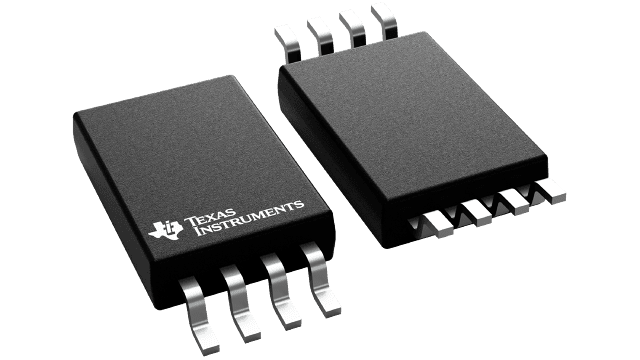
The Texas Instruments RC4558IPWR is a dual general-purpose operational amplifier designed for a variety of applications, particularly in audio. It operates with a wide supply voltage range from 10V to 30V.
Key electrical specifications include a typical gain bandwidth product of 3 MHz and a slew rate of 1.7 V/µs. The device exhibits low noise with a typical noise voltage density of 8 nV/√Hz at 1 kHz and low distortion with a typical THD + N of 0.0005% at 1 kHz. It also offers a typical output current of 0.01 A and a typical common-mode rejection ratio of 90 dB.
The RC4558IPWR is internally frequency compensated, eliminating the need for external components for stability. It is available in multiple package options including TSSOP, SOIC, VSSOP, SOP, and PDIP.
This operational amplifier is suitable for voltage-follower applications due to its high common-mode input voltage range and absence of latch-up. Its performance characteristics make it a versatile choice for audio circuits and other general-purpose amplification needs.
| Qty | Low | High |
|---|---|---|
| 1+ | $0.07 | $0.07 |
Estimated market price range - modelled values for guidance only, not live distributor offers.
The total supply voltage range is from 10 V to 30 V.
The typical gain bandwidth product is 3 MHz.
The typical slew rate is 1.7 V/µs.
The typical noise voltage density at 1 kHz is 8 nV/√Hz.
The typical THD + N at 1 kHz is 0.0005 %.
The operating temperature range is -40 °C to 85 °C.
The RC4558IPWR is available in TSSOP (PW), SOIC (D), VSSOP (DGK), SOP (PS), and PDIP (P) packages.