Ready to onboard?
Are you ready to join DistyParts and
grow your business?


| Distributor | Stock | Pricing | MOQ | PKG | Lead Time | Date Code | On Order Quantity | On Order Delivery | |
|---|---|---|---|---|---|---|---|---|---|
|
40 pcs
|
40 pcs | On Request | 1 | On Request | On Request | On Request | On Request | On Request |
| Category | |
| Manufacturer Name | |
| Applications | |
| Control Mode | |
| Current | |
| Duty Cycle | |
| Efficiency | |
| Features | |
| Height | |
| Input Voltage | |
| Length | |
| Mounting Type | |
| Number of Outputs | |
| Operating Temperature | |
| Output Voltage | |
| Switching Frequency | |
| Tape & Reel | |
| Topology | |
| Type | |
| Voltage | |
| Width |
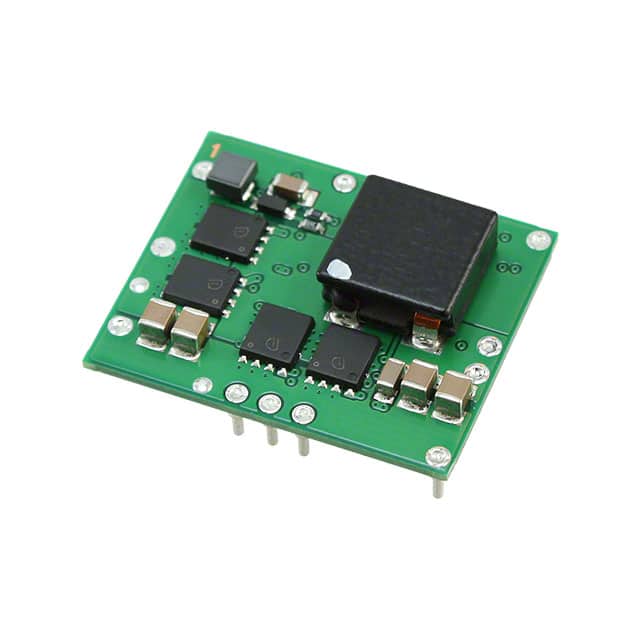
The Texas Instruments PTH05030WAD is a non-isolated Plug-in Power Module (PoL) designed for DC to DC conversion. It offers a high output current of up to 30A and accepts an input voltage range of 4.5V to 5.5V.
The module provides a wide output voltage adjustment from 0.8V to 3.6V, making it versatile for various applications. It operates with an efficiency of up to 94% and features a switching frequency between 275kHz and 325kHz. The control mode is voltage mode, and it supports features like Enable, Output discharge, and Tracking.
Designed for through-hole mounting, the PTH05030WAD comes in a 13-DIP Module package. Its dimensions are 34.8mm in length, 28.4mm in width, and 8.9mm in height. The operating temperature range is from -40°C to 85°C.
This power module is suitable for ITE (Commercial) applications and is compatible with the Point-of-Load Alliance (POLA) standard. It includes protections such as output over-current and over-temperature protection.
| Qty | Low | High |
|---|---|---|
| 1+ | $25.60 | $25.60 |
Estimated market price range - modelled values for guidance only, not live distributor offers.
The maximum output current is 30A.
The input voltage range is 4.5V to 5.5V.
The output voltage can be adjusted from 0.8V to 3.6V.
The operating temperature range is -40°C to 85°C.
It is a 13-DIP Module package.
It is mounted using the Through Hole method.
The efficiency is up to 94%.