

| Distributor | Stock | Pricing | MOQ | PKG | Lead Time | Date Code | On Order Quantity | On Order Delivery | |
|---|---|---|---|---|---|---|---|---|---|
|
10,000 pcs
|
10000 pcs | On Request | 1 | On Request | On Request | On Request | On Request | On Request | |
|
1,638 pcs
|
1638 pcs | On Request | 1 | On Request | On Request | On Request | On Request | On Request |
| Category | |
| Manufacturer Name | |
| AEC Qualified | |
| Automotive Grade | |
| Clock Sync | |
| Control Features | |
| Duty Cycle (Max) | |
| Frequency | |
| Function | |
| Lead Spacing | |
| Lead Style | |
| Mounting Type | |
| Number of Outputs | |
| Operating Temperature | |
| Output Configuration | |
| Output Phases | |
| Output Type | |
| Supplier Device Package | |
| Synchronous Rectifier | |
| Tape & Reel | |
| Topology | |
| Voltage |
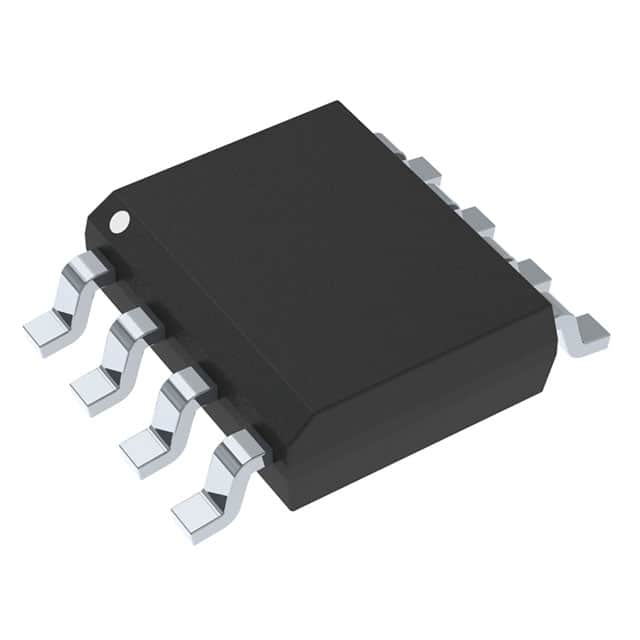
The NCV887103D1R2G from ON Semiconductor is an adjustable output, non-synchronous boost controller. It drives an external N-channel MOSFET and utilizes peak current mode control with internal slope compensation. This IC is suitable for applications requiring a wide input voltage range, from 3.2 V to 40 V, with a 45 V load dump capability.
Key features include a fixed switching frequency of 340 kHz, internal soft-start, undervoltage lockout, cycle-by-cycle current limiting, and thermal shutdown protection. The device also offers a low quiescent current in sleep mode and external synchronization capability.
Packaged in an 8-SOIC format, the NCV887103D1R2G is designed for surface mount applications. Its robust protection features make it a reliable choice for various power management designs.
| Qty | Low | High |
|---|---|---|
| 1+ | $0.78 | $0.78 |
Estimated market price range - modelled values for guidance only, not live distributor offers.
The input voltage range is 3.2V to 40V, with a 45V load dump capability.
The device is packaged in an 8-SOIC (0.154", 3.90mm Width) surface mount package.
The operating junction temperature range is -40°C to 150°C.
The switching frequency is fixed at 340kHz.
It supports boost and flyback topologies.
The maximum duty cycle is 93%.
No, it is a non-synchronous controller.