

| Distributor | Stock | Pricing | MOQ | PKG | Lead Time | Date Code | On Order Quantity | On Order Delivery | |
|---|---|---|---|---|---|---|---|---|---|
|
7,926 pcs
|
7926 pcs | On Request | 1 | On Request | On Request | 11+ | On Request | On Request | |
|
4,000 pcs
|
4000 pcs | On Request | 1 | On Request | On Request | On Request | On Request | On Request | |
|
1,000 pcs
|
1000 pcs | On Request | 1 | On Request | On Request | On Request | On Request | On Request |
| Category | |
| Manufacturer Name | |
| Circuit | |
| Independent Circuits | |
| Mounting Type | |
| Operating Temperature | |
| Operating Voltage | |
| Power Consumption | |
| Propagation Delay | |
| Supplier Device Package | |
| Supplier Package | |
| Type | |
| Voltage | |
| Voltage Supply Source |
The NB4N840MMNR4G from On Semiconductor is a high-bandwidth, fully differential dual 2x2 crosspoint switch designed for high-speed switching applications. It is suitable for SDH/SONET, DWDM, and Gigabit Ethernet systems.
This device supports a maximum input data frequency of 3.2 Gb/s and a maximum input clock frequency of 2.7 GHz. It offers low jitter accumulation, crosstalk, and signal skew due to its fully differential design. The NB4N840MMNR4G features internally terminated CML inputs and outputs, eliminating the need for external components and minimizing interface reflections. Differential 16 mA CML outputs provide 400 mV output swings when externally terminated.
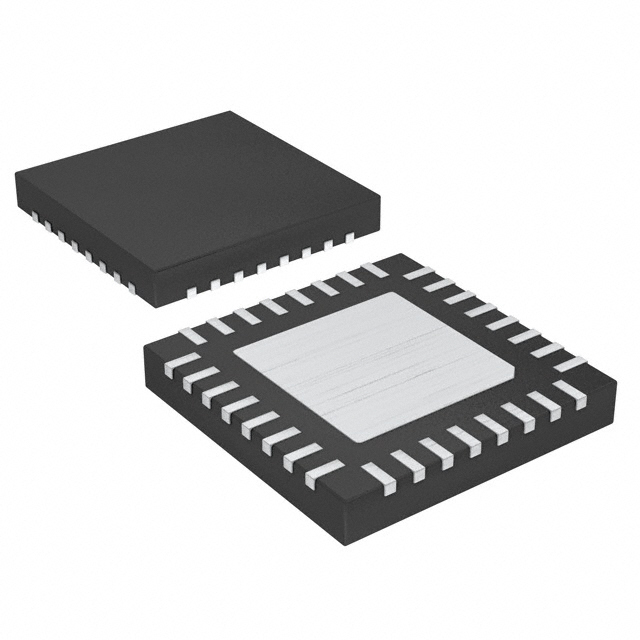
The crosspoint switch is configurable as a 1:2 fan-out, repeater, or a 2x2 crosspoint switch using single-ended LVCMOS/LVTTL SEL inputs. It operates from a single supply voltage of 3.0 V to 3.6 V and has a typical power consumption of 430 mW. The device is housed in a low-profile 5x5 mm 32-pin QFN package, suitable for surface mounting.
Key electrical characteristics include a typical propagation delay of 225 ps, typical rise and fall times of 80 ps, and channel-to-channel skew of 7 ps. It also boasts < 0.5 ps RMS jitter and 7 ps peak-to-peak data dependent jitter. The operating temperature range is -40°C to 85°C.
| Qty | Low | High |
|---|---|---|
| 1+ | $1.27 | $1.27 |
Estimated market price range - modelled values for guidance only, not live distributor offers.
The maximum input data frequency is 3.2 Gb/s.
The operating voltage range is 3.0 V to 3.6 V.
The operating temperature range is -40°C to 85°C.
It comes in a 32-QFN (5x5 mm) package with an exposed pad.
Typical power consumption is 430 mW.
Typical propagation delay is 225 ps.