

| Distributor | Stock | Pricing | MOQ | PKG | Lead Time | Date Code | On Order Quantity | On Order Delivery | |
|---|---|---|---|---|---|---|---|---|---|
|
7,840 pcs
|
7840 pcs | On Request | 1 | On Request | On Request | 0636+ | On Request | On Request |
| Category | |
| Manufacturer Name | |
| Channel Type | |
| Channels per Circuit | |
| Data Rate | |
| Halogen Free | |
| Input Signal | |
| Mounting Type | |
| Number of Circuits | |
| Operating Temperature | |
| Operating Voltage | |
| Output Signal | |
| Output Type | |
| Propagation Delay | |
| Supplier Device Package | |
| Supplier Package | |
| Translator Type |
The NB100LVEP91MN from On Semiconductor is a triple any level positive input to NECL output translator. This device is designed to accept various logic levels including LVPECL, LVTTL, LVCMOS, HSTL, CML, and LVDS, translating them into differential LVNECL output signals. It operates with a VCC range of 2.375 V to 3.8 V and a VEE range of -2.375 V to -3.8 V.
Key electrical specifications include a maximum input clock frequency exceeding 2.0 GHz and a maximum input data rate over 2.0 Gb/s. The typical propagation delay is 500 ps, making it suitable for high-speed applications. The device features unidirectional channels and a single circuit configuration.
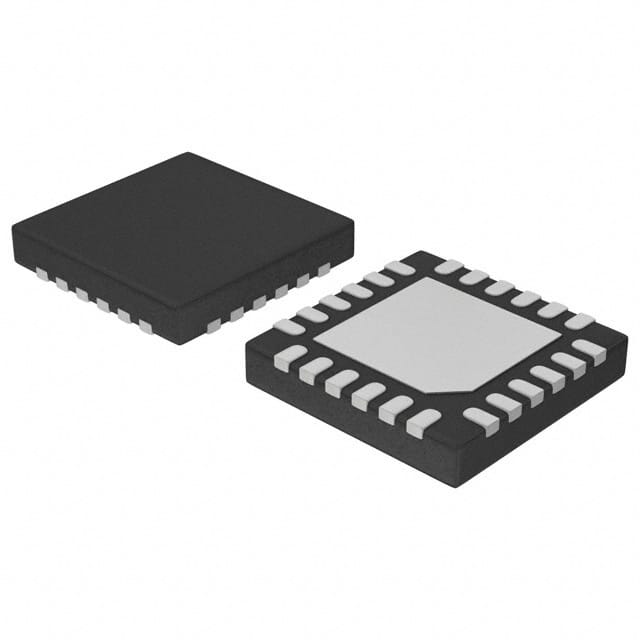
Packaged in a 24-VFQFN exposed pad, the NB100LVEP91MN is designed for surface mounting. It operates within an ambient temperature range of -40°C to 85°C. The device is Pb-free and Halogen free, with RoHS3 compliance and MSL 1 rating.
| Qty | Low | High |
|---|---|---|
| 1+ | $0.12 | $0.12 |
Estimated market price range - modelled values for guidance only, not live distributor offers.
The maximum input clock frequency is typically greater than 2.0 GHz.
The typical propagation delay is 500 ps.
The operating voltage ranges are 2.375 V to 3.8 V for VCC and -3.8 V to -2.375 V for VEE.
The operating temperature range is -40°C to 85°C (TA).
The NB100LVEP91MN is supplied in a 24-VFQFN exposed pad package.
Yes, the device is RoHS3 Compliant.
It accepts CML, HSTL, LVCMOS, LVDS, LVPECL, and LVTTL input signals.