

| Distributor | Stock | Pricing | MOQ | PKG | Lead Time | Date Code | On Order Quantity | On Order Delivery | |
|---|---|---|---|---|---|---|---|---|---|
|
4,536 pcs
|
4536 pcs | On Request | 1 | On Request | On Request | On Request | On Request | On Request |
| Category | |
| Manufacturer Name | |
| Clock Rate | |
| Interface | |
| Mounting Type | |
| Non | |
| On | |
| Operating Temperature | |
| Supplier Device Package | |
| Tape & Reel | |
| Type | |
| Voltage |
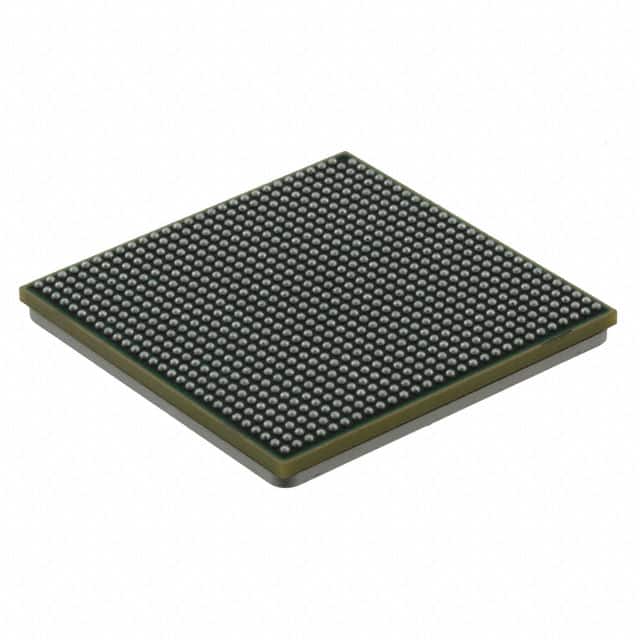
The MSC8157ESAG1000A from NXP Semiconductors is a high-performance Digital Signal Processor (DSP) designed for demanding embedded applications. It features six StarCore SC3850 DSP cores, each capable of operating at a clock rate of 1GHz.
This DSP integrates significant on-chip memory, including 3072 KB of M3 memory, 512 KB of L2 cache, and 32 KB each of L1 instruction and data cache. It also includes a 96 KB boot ROM and 6.375 MB of total on-chip memory. The device supports a wide range of interfaces such as Ethernet, I²C, PCI, Serial RapidIO, SGMII, SPI, and UART/USART.
Designed for operation between 0°C and 105°C (TJ), the MSC8157ESAG1000A operates at voltages of 1.0V, 1.5V, and 2.5V. It is supplied in a 783-BBGA, FCBGA package, suitable for surface mounting.
Key features include a Security Engine optimized for various cryptographic algorithms and a Multi-Accelerator Platform Engine for Baseband (MAPLE-B2) supporting advanced signal processing tasks like Turbo encoding, Viterbi decoding, and FFT/iFFT operations. It also includes DDR controllers with up to a 667 MHz clock.
| Qty | Low | High |
|---|---|---|
| 1+ | $33.86 | $33.86 |
Estimated market price range - modelled values for guidance only, not live distributor offers.
The clock rate of the MSC8157ESAG1000A is 1 GHz.
The MSC8157ESAG1000A features six SC3850 DSP cores.
The operating temperature range for the MSC8157ESAG1000A is 0°C to 105°C (TJ).
The MSC8157ESAG1000A is supplied in a 783-BBGA, FCBGA package.
The MAPLE-B2 engine supports Turbo encoding/decoding, Viterbi decoding, FFT/iFFT and DFT/iDFT processing, downlink chip rate processing, CRC processing/insertion, equalization processing, matrix inversion, and uplink batch/fast processing.