

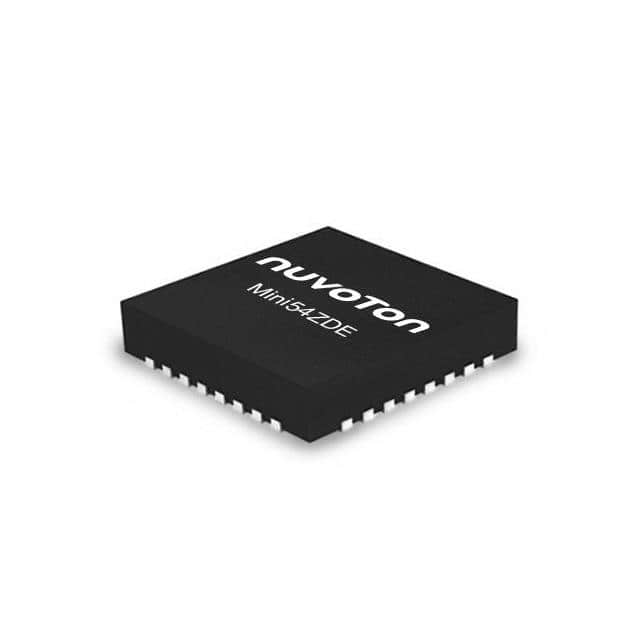
| Distributor | Stock | Pricing | MOQ | PKG | Lead Time | Date Code | On Order Quantity | On Order Delivery | |
|---|---|---|---|---|---|---|---|---|---|
|
750 pcs
|
750 pcs | On Request | 1 | On Request | On Request | On Request | On Request | On Request |
| Category | |
| Manufacturer Name | |
| Connectivity | |
| Core Processor | |
| Core Size | |
| Data Converters | |
| Frequency | |
| Mounting Type | |
| Number of I | |
| Operating Temperature | |
| Oscillator Type | |
| Peripherals | |
| Program Memory Size | |
| Program Memory Type | |
| RAM Size | |
| Speed | |
| Supplier Device Package | |
| Voltage |
The Nuvoton MINI54ZDE is a 32-bit microcontroller based on the ARM Cortex-M0 core, designed for embedded applications. It operates at a maximum frequency of 24MHz and supports a wide voltage range from 2.5V to 5.5V.
Key memory features include 16KB of Flash memory for program storage and 2KB of SRAM. The device is equipped with various peripherals such as an 8-channel, 10-bit ADC, up to six-channel PWM outputs, and connectivity options including SPI, I2C, and UART.
This microcontroller is housed in a 33-QFN (5x5) package and is suitable for surface mount applications. It operates within a temperature range of -40°C to 105°C, making it robust for various environmental conditions. The MINI54ZDE series is targeted for applications like security systems, temperature sensors, and motor control.
Additional features include internal oscillator with ±1% accuracy at 25°C, 5V, and support for In-System Programming (ISP), In-Circuit Programming (ICP), and In-Application Programming (IAP).
| Qty | Low | High |
|---|---|---|
| 1+ | $6.40 | $6.40 |
Estimated market price range - modelled values for guidance only, not live distributor offers.
The MINI54ZDE operates from 2.5V to 5.5V.
The operating temperature range is -40°C to 105°C.
The MINI54ZDE is available in a 33-QFN (5x5) package.
The MINI54ZDE has 16KB of Flash memory.
The MINI54ZDE operates at a maximum frequency of 24 MHz.
Connectivity options include I²C, IrDA, SPI, and UART/USART.