

| Distributor | Stock | Pricing | MOQ | PKG | Lead Time | Date Code | On Order Quantity | On Order Delivery | |
|---|---|---|---|---|---|---|---|---|---|
|
120 pcs
|
120 pcs | On Request | 1 | On Request | On Request | On Request | On Request | On Request |
| Category | |
| Manufacturer Name | |
| Antenna Type | |
| Data Rate | |
| Frequency | |
| Mounting Type | |
| Operating Temperature | |
| Output Power | |
| Package / Case | |
| Sensitivity | |
| Serial Interfaces |
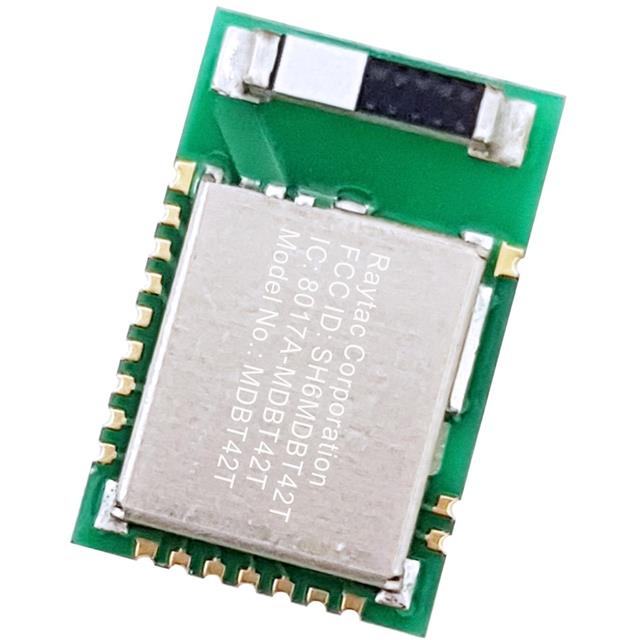
The Raytac MDBT42T-192K is a compact RF transceiver module designed for wireless communication applications. It supports multiple protocols including 802.15.4, Bluetooth v5.0, Bluetooth v5.1, and Zigbee, making it versatile for various IoT and connectivity solutions.
This module operates in the 2.4GHz frequency band and offers a data rate of up to 2Mbps. Key electrical specifications include an output power of 8dBm, a receiving sensitivity of -103dBm, and a supply voltage range of 1.7V to 3.6V. It consumes minimal current, with receiving current between 3.4mA and 10.9mA, and transmitting current between 2.3mA and 30mA.
Featuring 192kB of Flash memory and 24kB of RAM, the MDBT42T-192K provides ample space for firmware and data. It includes serial interfaces such as GPIO, I2C, SPI, UART, and USB for easy integration into embedded systems. The module is housed in a 31-SMD module package and is designed for surface mounting.
With an operating temperature range of -40°C to 105°C, this module is suitable for demanding environments. The integrated chip antenna simplifies design and reduces board space.
| Qty | Low | High |
|---|---|---|
| 1+ | $0.99 | $0.99 |
Estimated market price range - modelled values for guidance only, not live distributor offers.
The MDBT42T-192K supports 802.15.4, Bluetooth v5.0, Bluetooth v5.1, and Zigbee protocols.
The module operates at a frequency of 2.4GHz.
The maximum output power is 8dBm.
The supply voltage range is from 1.7V to 3.6V.
The operating temperature range is -40°C to 105°C.
It has 192kB of Flash memory and 24kB of RAM.
Supported serial interfaces include GPIO, I2C, SPI, UART, and USB.