

| Distributor | Stock | Pricing | MOQ | PKG | Lead Time | Date Code | On Order Quantity | On Order Delivery | |
|---|---|---|---|---|---|---|---|---|---|
|
2,400 pcs
|
2400 pcs | On Request | 1 | On Request | On Request | On Request | On Request | On Request |
| Category | |
| Manufacturer Name | |
| Architecture | |
| Configuration | |
| Data Interface | |
| Input Type | |
| Lead Spacing | |
| Mounting Type | |
| Number of A | |
| Number of Bits | |
| Number of Inputs | |
| Operating Temperature | |
| Ratio | |
| Reference Type | |
| Sampling Rate (Per Second) | |
| Supplier Device Package | |
| Supplier Package | |
| Tape & Reel | |
| Voltage |
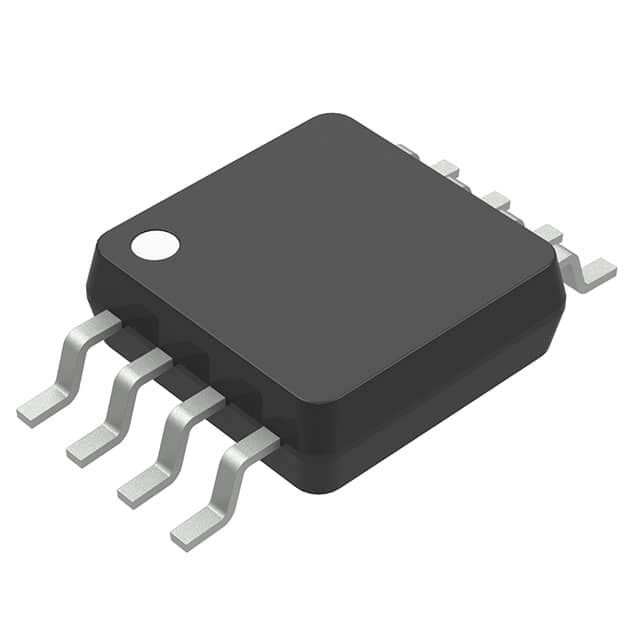
The MCP3002-I/MS from Microchip Technology is a 10-bit successive approximation analog-to-digital converter (ADC) with on-board sample and hold circuitry. It supports an SPI serial interface and can be programmed for single pseudo-differential or dual single-ended inputs.
This ADC offers a 10-bit resolution with ±1 LSB maximum Differential Nonlinearity (DNL) and Integral Nonlinearity (INL). It operates from a single supply voltage ranging from 2.7V to 5.5V. The maximum sampling rate is 200 ksps at 5V and 75 ksps at 2.7V.
Designed for low power consumption, the MCP3002-I/MS features a typical standby current of 5 nA and a maximum active current of 550 µA. It is suitable for applications requiring sensor interfacing, process control, data acquisition, and battery-operated systems.
The device is available in an 8-MSOP package and operates within an industrial temperature range of -40°C to +85°C. Its mounting type is surface mount.
| Qty | Low | High |
|---|---|---|
| 1+ | $8.35 | $8.35 |
Estimated market price range - modelled values for guidance only, not live distributor offers.
The MCP3002-I/MS has a 10-bit resolution.
The maximum sampling rate at 5V is 200 kSPS.
The operating voltage range is 2.7V to 5.5V.
The operating temperature range is -40°C to +85°C.
The MCP3002-I/MS uses an SPI serial interface.
The MCP3002-I/MS is supplied in an 8-MSOP package.
The Differential Nonlinearity (DNL) and Integral Nonlinearity (INL) are both ±1 LSB maximum.