

| Distributor | Stock | Pricing | MOQ | PKG | Lead Time | Date Code | On Order Quantity | On Order Delivery | |
|---|---|---|---|---|---|---|---|---|---|
|
2,500 pcs
|
2500 pcs | On Request | 1 | On Request | On Request | On Request | On Request | On Request |
| Category | |
| Manufacturer Name | |
| Current | |
| Frequency | |
| Function | |
| Mounting Type | |
| Number of Outputs | |
| Operating Temperature | |
| Output Configuration | |
| Output Type | |
| Supplier Device Package | |
| Supplier Package | |
| Synchronous Rectifier | |
| Topology | |
| Voltage |
The ON Semiconductor MC34166TG is a high-performance fixed-frequency power switching regulator designed for DC-to-DC conversion applications. It can be used in step-down, voltage-inverting, and step-up configurations with minimal external components.
Key electrical specifications include an output switch current in excess of 3.0 A, a fixed oscillator frequency of 72 kHz, and an adjustable output. The device operates from a wide input voltage range of 7.5 V to 40 V. Protective features include cycle-by-cycle current limiting, undervoltage lockout, and thermal shutdown.
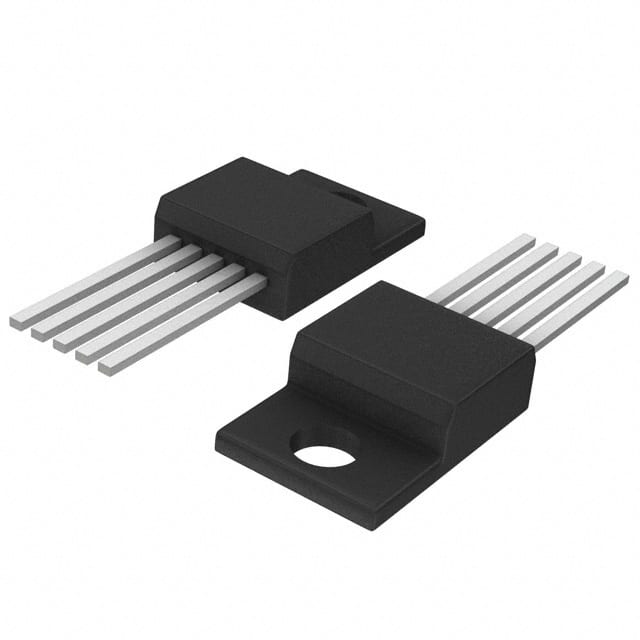
This regulator is available in a 5-lead TO-220 package, suitable for through-hole mounting. It offers an output duty cycle range of 0% to 95% and includes a precision 2% reference. The device also features a low power standby mode that reduces supply current.
Designed for reliability, the MC34166TG includes internal thermal shutdown and undervoltage lockout with hysteresis. It is suitable for various power supply designs requiring efficient voltage regulation.
| Qty | Low | High |
|---|---|---|
| 1+ | $1.08 | $1.08 |
Estimated market price range - modelled values for guidance only, not live distributor offers.
The minimum input voltage is 7.5V and the maximum is 40V.
The maximum output switch current is 3.3A.
The switching frequency is fixed at 72 kHz.
The MC34166TG is available in a TO-220-5 through-hole package.
The operating temperature range is 0°C to 70°C.
Yes, the output type is adjustable.
It supports buck (step-down) and boost (step-up) topologies.