

| Distributor | Stock | Pricing | MOQ | PKG | Lead Time | Date Code | On Order Quantity | On Order Delivery | |
|---|---|---|---|---|---|---|---|---|---|
|
84 pcs
|
84 pcs | On Request | 1 | On Request | On Request | On Request | On Request | On Request |
| Category | |
| Manufacturer Name | |
| Clock Frequency | |
| Current | |
| Function | |
| Input Capacitance | |
| Max Propagation Delay @ V, Max CL | |
| Mounting Type | |
| Number of Bits per Element | |
| Number of Elements | |
| Operating Temperature | |
| Operating Voltage | |
| Output Type | |
| Power Dissipation | |
| Supplier Device Package | |
| Trigger Type | |
| Type | |
| Voltage |
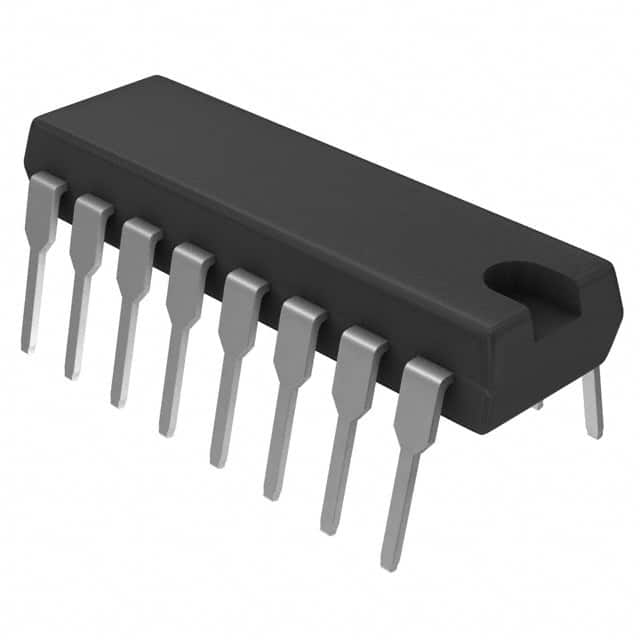
The MC14076BCPG from ON Semiconductor is a 4-bit D-type register featuring synchronous operation from a common clock and three-state outputs for bus-organized systems. It includes an asynchronous master reset for clearing all flip-flops independently of the clock or disable inputs.
This device operates over a wide supply voltage range of 3V to 18V and has a clock frequency of up to 12 MHz. The operating temperature range is -55°C to 125°C (TA). It is designed for applications requiring bus buffering and data storage.
The MC14076BCPG is available in a 16-PDIP package and supports through-hole mounting. Its output type is Tri-State, Non-Inverted, and it has an input capacitance of 5 pF. The maximum propagation delay is 180ns at 15V and 50pF.
Key features include four bus buffer registers, gated control lines for three-state outputs, and independent clock operation for parallel load and do-nothing modes. The device is capable of driving two low-power TTL loads or one low-power Schottky TTL load.
| Qty | Low | High |
|---|---|---|
| 1+ | $0.86 | $0.86 |
Estimated market price range - modelled values for guidance only, not live distributor offers.
The supply voltage range is 3 Vdc to 18 Vdc.
The ambient temperature range is -55°C to 125°C.
It is available in a 16-PDIP (16-DIP, 0.300 inch, 7.62 mm) through-hole package.
The maximum clock frequency is 12 MHz.
Yes, it includes a master reset function.
The outputs are tri-state and non-inverted.