

| Distributor | Stock | Pricing | MOQ | PKG | Lead Time | Date Code | On Order Quantity | On Order Delivery | |
|---|---|---|---|---|---|---|---|---|---|
|
5,486 pcs
|
5486 pcs | On Request | 1 | On Request | On Request | On Request | On Request | On Request | |
|
3,659 pcs
|
3659 pcs | On Request | 1 | On Request | On Request | On Request | On Request | On Request |
| Category | |
| Manufacturer Name | |
| Channel Type | |
| Channels per Circuit | |
| Halogen Free | |
| Input Signal | |
| Mounting Type | |
| Number of Circuits | |
| Operating Temperature | |
| Operating Voltage | |
| Output Signal | |
| Output Type | |
| Propagation Delay | |
| Supplier Device Package | |
| Supplier Package | |
| Translator Type |
The MC100EPT24DG from On Semiconductor is a versatile LVTTL/LVCMOS to Differential LVECL translator. This device is ideal for applications requiring space, performance, and low power, featuring a typical propagation delay of 350 ps and a maximum input clock frequency exceeding 1.0 GHz.
It operates within a voltage range of 3.0 V to 3.6 V for VCC and -3.6 V to -3.0 V for VEE, requiring a ground connection. The translator utilizes a PNP LVTTL input for minimal loading and offers differential LVECL outputs. The Q output defaults HIGH with the input open.
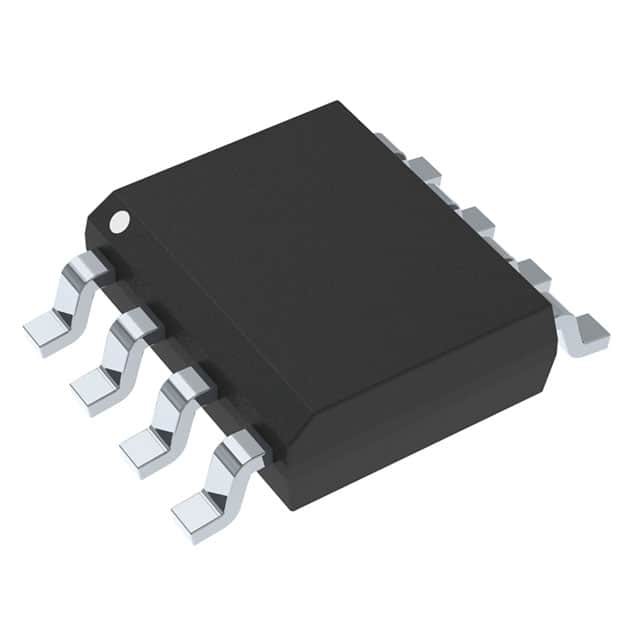
This component is supplied in an 8-SOIC surface-mount package. It is designed for operation in ambient temperatures ranging from -40°C to 85°C. The device is Pb-Free and Halogen Free, meeting RoHS compliance standards.
| Qty | Low | High |
|---|---|---|
| 1+ | $0.12 | $0.12 |
Estimated market price range - modelled values for guidance only, not live distributor offers.
The typical propagation delay is 350 ps.
The maximum input clock frequency is greater than 1.0 GHz.
The device requires dual supplies: VCC from 3.0 V to 3.6 V and VEE from -3.6 V to -3.0 V, with GND at 0 V.
The operating temperature range is -40°C to 85°C.
The MC100EPT24DG is available in an 8-SOIC surface-mount package with a 3.90 mm width.
Yes, the MC100EPT24DG is Pb-free and halogen free.
ESD protection exceeds 4 kV (Human Body Model), 200 V (Machine Model), and 2 kV (Charged Device Model).