

| Distributor | Stock | Pricing | MOQ | PKG | Lead Time | Date Code | On Order Quantity | On Order Delivery | |
|---|---|---|---|---|---|---|---|---|---|
|
299 pcs
|
299 pcs | On Request | 1 | On Request | On Request | On Request | On Request | On Request |
| Category | |
| Manufacturer Name | |
| Channel | |
| Channel Capacitance (CS(off), CD(off)) | |
| Charge Injection | |
| Crosstalk | |
| Current | |
| Lead Spacing | |
| Mounting Type | |
| Multiplexer | |
| Number of Circuits | |
| On | |
| Operating Temperature | |
| Supplier Device Package | |
| Supplier Package | |
| Switch Circuit | |
| Switch Time (Ton, Toff) (Max) | |
| Voltage |
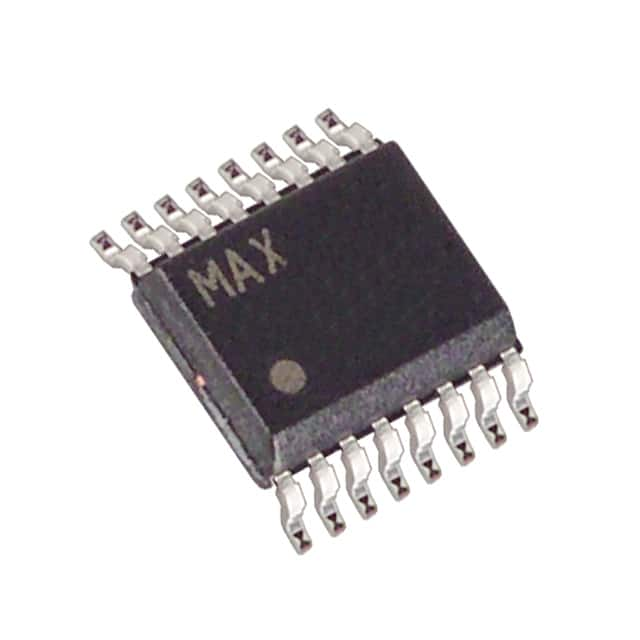
The MAX4559EEE+ is a low-voltage, CMOS analog IC configured as a dual 4-to-1 multiplexer. It is designed to handle Rail-to-Rail analog signals and operates from dual supplies of ±2V to ±6V or a single +2V to +12V supply.
Key electrical specifications include a typical on-resistance of 160Ω with ±5V supplies and 220Ω with a single +5V supply. It offers low crosstalk of -93dB at 100kHz and high off-isolation of -96dB at 50Ω. The switch time is rated at 150ns for turn-on and 120ns for turn-off.
This device features ESD protection on its pins, rated for ±15kV (Human Body Model). It is pin-compatible with industry-standard devices like the 74HC4052. The MAX4559EEE+ is suitable for applications such as battery-operated equipment, audio and video signal routing, low-voltage data-acquisition systems, and communications circuits.
The component is supplied in a 16-QSOP package and is designed for surface mounting. It operates within an ambient temperature range of -40°C to 85°C.
| Qty | Low | High |
|---|---|---|
| 1+ | $0.30 | $0.30 |
Estimated market price range - modelled values for guidance only, not live distributor offers.
The MAX4559EEE+ operates from ±2V to ±6V.
The typical on-resistance is 160Ω with ±5V supplies.
The operating temperature range is -40°C to 85°C.
The MAX4559EEE+ is supplied in a 16-QSOP package.
The crosstalk is -93dB at 100kHz.
The off-isolation is -96dB at 50Ω.