

| Distributor | Stock | Pricing | MOQ | PKG | Lead Time | Date Code | On Order Quantity | On Order Delivery | |
|---|---|---|---|---|---|---|---|---|---|
|
240 pcs
|
240 pcs | On Request | 1 | On Request | On Request | 10+ | On Request | On Request |
| Category | |
| Manufacturer Name | |
| Clock Sync | |
| Control Features | |
| Frequency | |
| Function | |
| Mounting Type | |
| Number of Outputs | |
| Operating Temperature | |
| Operating Voltage | |
| Output Configuration | |
| Output Phases | |
| Output Type | |
| SVHC Present | |
| Supplier Device Package | |
| Supplier Package | |
| Synchronous Rectifier | |
| Topology | |
| Voltage |
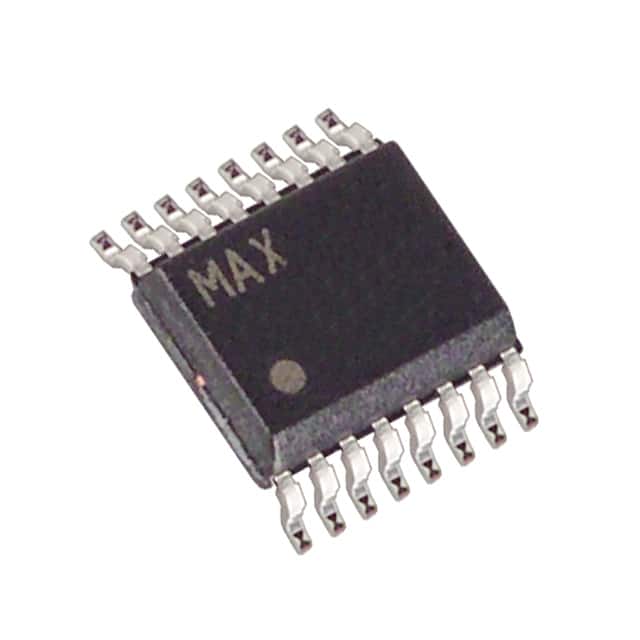
The Analog Devices MAX1761EEE is a dual pulse-width-modulation (PWM) step-down controller. It provides high efficiency, excellent transient response, and high DC output accuracy in a compact circuit topology. These features are essential for stepping down high-voltage batteries to generate low-voltage CPU core, I/O, and chipset RAM supplies in space-critical applications like notebook computers and smartphones.
Maxim’s proprietary Quick-PWM control scheme handles wide input/output voltage ratios and provides instant-on response to load transients while maintaining a relatively constant switching frequency. The MAX1761 achieves high efficiency by eliminating the current-sense resistor and employs a complementary MOSFET output stage, reducing component count. It is intended for CPU core, chipset, DRAM, or other low-voltage supplies.
The device features a 5V to 20V input range and operates with a switching frequency of 250kHz or 350kHz. It offers ±1% total DC error in forced-PWM mode and includes an Enable control feature. The MAX1761 is available in a 16-pin QSOP package, suitable for surface mount applications.
Applications include notebooks, PDAs, digital cameras, handy-terminals, and smartphones requiring 1.8V/2.5V logic and I/O supplies.
| Qty | Low | High |
|---|---|---|
| 1+ | $0.78 | $0.78 |
Estimated market price range - modelled values for guidance only, not live distributor offers.
The input voltage range is 4.5V to 20V.
The operating temperature range is -40°C to 85°C (TA).
The MAX1761EEE is available in a 16-QSOP package and a 16-SSOP (0.154", 3.90mm Width) package.
The RoHS status is RoHS3 Compliant.
The Moisture Sensitivity Level is 1 Unlimited.
The switching frequency is 250kHz or 350kHz.
The total DC error in forced-PWM mode is ±1%.