

| Distributor | Stock | Pricing | MOQ | PKG | Lead Time | Date Code | On Order Quantity | On Order Delivery | |
|---|---|---|---|---|---|---|---|---|---|
|
10,044 pcs
|
10044 pcs | On Request | 1 | On Request | On Request | On Request | On Request | On Request |
| Category | |
| Manufacturer Name | |
| Current | |
| Frequency | |
| Function | |
| Mounting Type | |
| Number of Outputs | |
| Operating Temperature | |
| Output Configuration | |
| Output Type | |
| SVHC Present | |
| Supplier Device Package | |
| Supplier Package | |
| Synchronous Rectifier | |
| Tape & Reel | |
| Topology | |
| Voltage |
The MAX15021ATI+T from Analog Devices is a dual-output, pulse-width-modulated (PWM) step-down DC-DC regulator. It operates from a 2.5V to 5.5V input supply and provides adjustable output voltages from 0.6V to the input supply. Regulator 1 can deliver up to 4A, while regulator 2 supports up to 2A.
This device features a programmable switching frequency ranging from 500kHz to 4MHz, allowing for optimization of design size and performance. It utilizes a voltage-mode control scheme with external compensation for flexibility. The dual regulators operate 180° out-of-phase, reducing input ripple current and the need for large input bypass capacitors.
Additional capabilities include tracking (coincident or ratiometric) and sequencing options for power-up and power-down, with glitch-free operation into a prebiased output during sequencing. Protection features include cycle-by-cycle current limit, hiccup-mode output short-circuit protection, and thermal shutdown.
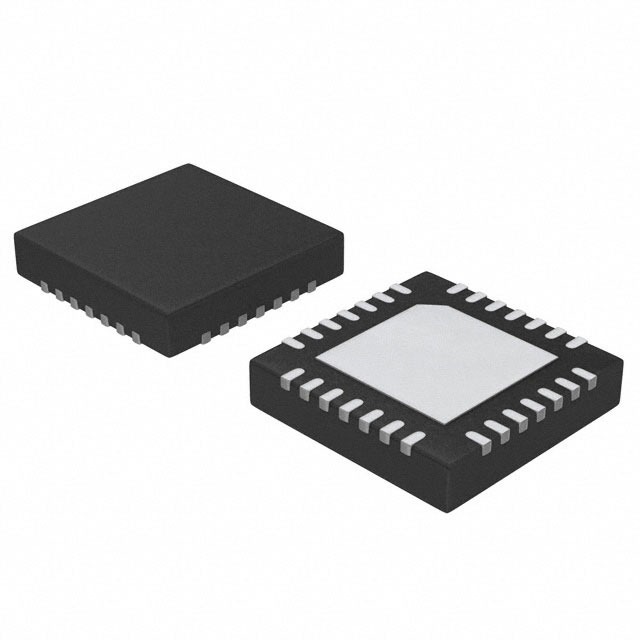
The MAX15021ATI+T is available in a compact 5mm x 5mm, 28-pin TQFN-EP package, suitable for space-constrained designs. It is specified for operation across a wide temperature range of -40°C to +125°C.
| Qty | Low | High |
|---|---|---|
| 1+ | $1.08 | $1.08 |
Estimated market price range - modelled values for guidance only, not live distributor offers.
2.5V to 5.5V.
28-WFQFN Exposed Pad (28-TQFN 5x5mm).
-40°C to 125°C.
Adjustable from 0.6V to V_in.
2A and 4A.
500kHz to 4MHz.
Yes.