

| Distributor | Stock | Pricing | MOQ | PKG | Lead Time | Date Code | On Order Quantity | On Order Delivery | |
|---|---|---|---|---|---|---|---|---|---|
|
2,298 pcs
|
2298 pcs | On Request | 1 | On Request | On Request | On Request | On Request | On Request |
| Category | |
| Manufacturer Name | |
| Connectivity | |
| Core Processor | |
| Core Size | |
| Data Converters | |
| Lead Spacing | |
| Mounting Type | |
| Number of I | |
| Operating Temperature | |
| Oscillator Type | |
| Peripherals | |
| Program Memory Type | |
| RAM Size | |
| Speed | |
| Supplier Device Package | |
| Supplier Package | |
| Voltage |
The NXP Semiconductors LPC1850FET180,551 is a microcontroller based on the ARM Cortex-M3 processor, designed for embedded applications. It operates at CPU frequencies up to 180 MHz and includes a 3-stage pipeline with a Harvard architecture for efficient data processing.
Key features include 200 kB of on-chip SRAM, a ROM containing boot code and drivers, and a ROMless program memory type. The microcontroller supports various peripherals such as a Quad SPI Flash Interface (SPIFI), a State Configurable Timer/PWM subsystem, two High-speed USB controllers, Ethernet, and an LCD controller. It also incorporates an external memory controller.
The processor core is an ARM Cortex-M3 (version r2p1) with a built-in Memory Protection Unit (MPU) supporting eight regions and a Nested Vectored Interrupt Controller (NVIC). It includes standard debug interfaces like JTAG and Serial Wire Debug, along with enhanced trace capabilities.
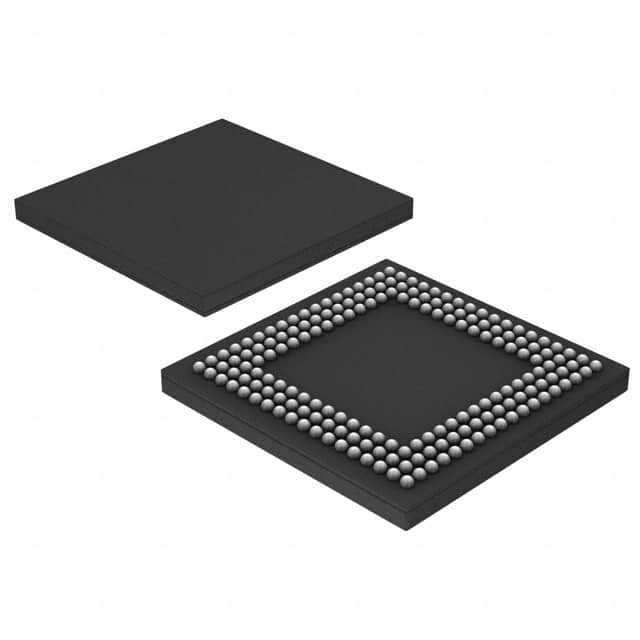
This device is available in a 180-TFBGA (12x12) surface mount package. It operates within a temperature range of -40°C to 85°C and requires a supply voltage between 2.2V and 3.6V.
The core processor is an ARM Cortex-M3.
The CPU frequency can run up to 180 MHz.
There is 200 kB of SRAM available for code and data use.
The operating voltage range is 2.2V to 3.6V.
The operating temperature range is -40°C to 85°C.
It is supplied in a 180-TFBGA package.
Connectivity includes CANbus, EBI/EMI, Ethernet, I²C, IrDA, Microwire, QEI, SD, SPI, SSI, SSP, UART/USART, USB, and USB OTG.