

| Distributor | Stock | Pricing | MOQ | PKG | Lead Time | Date Code | On Order Quantity | On Order Delivery | |
|---|---|---|---|---|---|---|---|---|---|
|
4,718 pcs
|
4718 pcs | On Request | 1 | On Request | On Request | 20+ | On Request | On Request | |
|
27 pcs
|
27 pcs | On Request | 1 | On Request | On Request | On Request | On Request | On Request |
| Category | |
| Manufacturer Name | |
| Differential | |
| Frequency | |
| Input | |
| Lead Spacing | |
| Mounting Type | |
| Number of Circuits | |
| Operating Temperature | |
| Output | |
| Ratio | |
| Supplier Device Package | |
| Type | |
| Voltage |
The Texas Instruments LMK00105SQE/NOPB is a high-performance, low-noise LVCMOS fanout buffer designed to distribute five ultra-low jitter clocks. It supports a universal input, accepting LVPECL, LVDS, HCSL, SSTL, LVCMOS, LVTTL, and crystal oscillator inputs. The device operates with a core supply voltage of 3.3 or 2.5-V and features adjustable output power supplies of 1.5 V, 1.8 V, 2.5 V, and 3.3 V for each bank.
With a maximum frequency of 200 MHz, the LMK00105 offers an output skew of 6 ps and additive phase jitter of 30 fs at 156.25 MHz. It is suitable for applications requiring precise clock distribution, such as networking, telecom, server, and storage area networking. The buffer supports synchronous output enable for glitch-free operation.
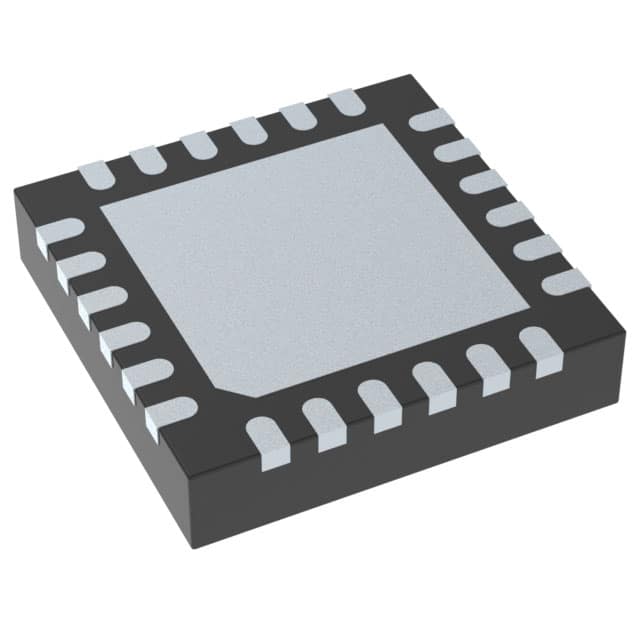
The LMK00105SQE/NOPB is housed in a compact 24-pin WQFN package measuring 4.0 mm x 4.0 mm x 0.8 mm, with a surface mount type. It operates within an ambient temperature range of -40°C to 85°C. The device is rated for RoHS3 compliance and has an MSL rating of 1.
| Qty | Low | High |
|---|---|---|
| 1+ | $3.29 | $3.29 |
Estimated market price range - modelled values for guidance only, not live distributor offers.
The LMK00105SQE/NOPB is an LVCMOS fanout buffer and level translator.
The LMK00105SQE/NOPB supports a maximum frequency of 200 MHz.
The LMK00105SQE/NOPB provides LVCMOS outputs.
The operating temperature range for the LMK00105SQE/NOPB is -40°C to 85°C.
The LMK00105SQE/NOPB is supplied in a 24-WQFN (4x4) package.
The output skew is 6 ps.
The additive phase jitter is 30 fs at 156.25 MHz (12 kHz to 20 MHz).