

| Distributor | Stock | Pricing | MOQ | PKG | Lead Time | Date Code | On Order Quantity | On Order Delivery | |
|---|---|---|---|---|---|---|---|---|---|
|
5 pcs
|
5 pcs | On Request | 1 | On Request | On Request | On Request | On Request | On Request |
| Category | |
| Manufacturer Name | |
| Accuracy | |
| Lead Style | |
| Mounting Type | |
| Noise | |
| Operating Temperature Range | |
| Output Current | |
| PSRR | |
| Quiescent Current | |
| Thermal Resistance |
The LM317AEMP from Texas Instruments is a versatile adjustable linear voltage regulator designed for a wide range of applications. It can supply over 1.5A of output current and provides an adjustable output voltage from 1.25V up to 37V, with an input voltage range of 3V to 40V.
Key electrical specifications include a typical dropout voltage of 2250mV, a typical quiescent current of 5mA, and a typical PSRR of 40dB at 100KHz. The device boasts 1% output voltage tolerance and 0.005%/V line regulation, ensuring stable power delivery. It also features constant current limiting and short-circuit protection for enhanced reliability.
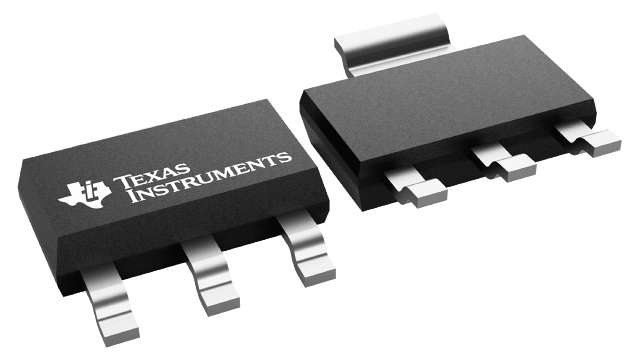
This regulator operates within a temperature range of -40°C to 125°C. It is available in multiple package options including SOT-223, TO-252, TO-CAN, and TO-220, supporting various mounting types. The LM317AEMP is suitable for applications requiring flexible and precise voltage regulation.
Designed for ease of use, the LM317AEMP does not require an external output capacitor. Its robust design and comprehensive protection features make it a reliable choice for power management solutions.
| Qty | Low | High |
|---|---|---|
| 1+ | $0.28 | $0.28 |
Estimated market price range - modelled values for guidance only, not live distributor offers.
The input voltage can range from 3V minimum to 40V maximum.
The maximum output current is 1.5A.
The output voltage is adjustable from 1.2V to 37V, and can be set down to 1.25V.
The device is available in SOT-223, TO-252, TO-220, and TO-CAN packages.
The operating temperature range is -40°C to +125°C.
No, an output capacitor is not required for stability.
Yes, the output is short-circuit protected.