

| Distributor | Stock | Pricing | MOQ | PKG | Lead Time | Date Code | On Order Quantity | On Order Delivery | |
|---|---|---|---|---|---|---|---|---|---|
|
4,729 pcs
|
4729 pcs | On Request | 1 | On Request | On Request | On Request | On Request | On Request | |
|
10 pcs
|
10 pcs | On Request | 1 | On Request | On Request | On Request | On Request | On Request |
| Category | |
| Manufacturer Name | |
| Current | |
| Duty Cycle (Max) | |
| Features | |
| Frequency | |
| Function | |
| Mounting Type | |
| Number of Outputs | |
| Operating Temperature | |
| Output Configuration | |
| Output Current | |
| Output Type | |
| Supplier Device Package | |
| Supplier Package | |
| Synchronous Rectifier | |
| Topology | |
| Voltage |
The Texas Instruments LM2592HVS-5.0/NOPB is a versatile DC/DC switching regulator designed for step-down (buck) conversion. It can deliver up to 2A of output current and accepts an input voltage range up to 60V.
This regulator operates at a fixed 150kHz switching frequency, simplifying design and reducing the need for external filtering components. The output voltage is adjustable, ranging from 1.2V to 57V, with a typical quiescent current of 90 μA in standby mode. Key features include enable functionality and over-current protection, enhancing system reliability.
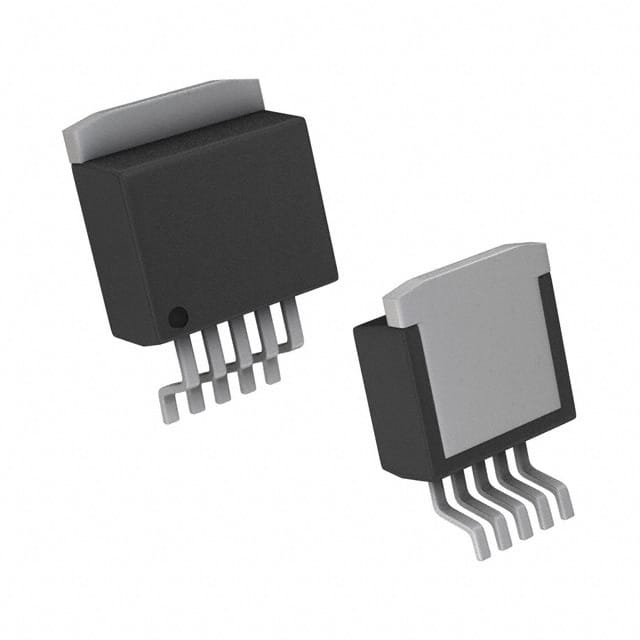
The LM2592HVS-5.0/NOPB is available in a TO-263-6, D²Pak package, suitable for surface mount applications. Its operating temperature range is -40°C to 125°C (TJ), making it suitable for a variety of environmental conditions. The device also includes thermal shutdown and current-limit protection.
This component is ideal for power management applications requiring efficient and stable voltage regulation within a wide input voltage range. Its fixed frequency and adjustable output make it a flexible choice for designs needing precise voltage control.
| Qty | Low | High |
|---|---|---|
| 1+ | $4.41 | $4.41 |
Estimated market price range - modelled values for guidance only, not live distributor offers.
The LM2592HVS-5.0/NOPB provides a fixed output voltage of 5V.
The maximum output current is 2A.
The input voltage range is 4.5V to 60V.
The operating temperature range is -40°C to 125°C.
It is available in a TO-263-6, D²Pak (5 Leads + Tab), TO-263BA surface-mount package.
The switching frequency is 150 kHz.
It uses a buck (step-down) topology.