

| Distributor | Stock | Pricing | MOQ | PKG | Lead Time | Date Code | On Order Quantity | On Order Delivery | |
|---|---|---|---|---|---|---|---|---|---|
|
1,982 pcs
|
1982 pcs | On Request | 1 | On Request | On Request | 20+ | On Request | On Request | |
|
960 pcs
|
960 pcs | On Request | 1 | On Request | On Request | On Request | On Request | On Request | |
| On Request | On Request | 1 | On Request | On Request | On Request | On Request | On Request |
| Category | |
| Manufacturer Name | |
| Current | |
| Frequency | |
| Function | |
| Halogen Free | |
| Mounting Type | |
| Number of Outputs | |
| Operating Temperature | |
| Operating Voltage | |
| Output Configuration | |
| Output Type | |
| Output Voltage | |
| Package Quantity | |
| Supplier Device Package | |
| Synchronous Rectifier | |
| Topology | |
| Voltage |
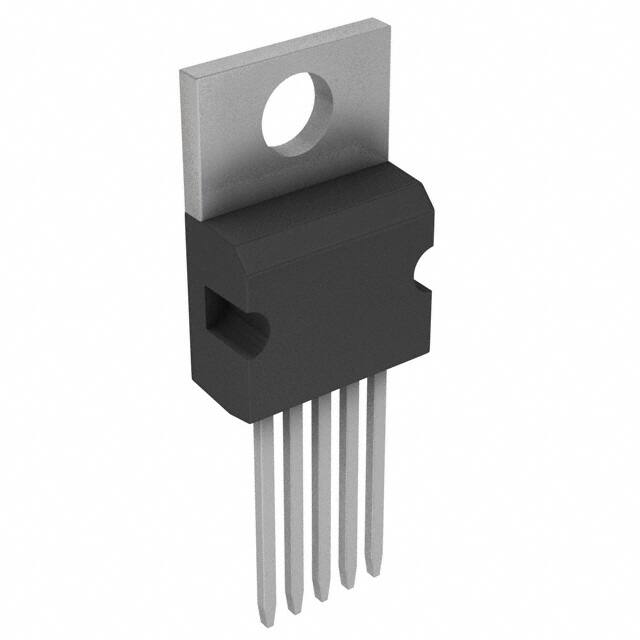
The Texas Instruments LM2576HVT-12/NOPB is a monolithic integrated circuit designed for step-down (buck) switching regulator applications. It is capable of driving a 3A load with excellent line and load regulation.
This regulator features a fixed 12V output voltage and operates from an input voltage range of 4V up to 60V. It requires a minimum number of external components, making it simple to use. The device includes fault protection and a fixed-frequency internal oscillator operating at 52kHz.
The LM2576 series offers a high-efficiency replacement for linear regulators, substantially reducing the size of the required heat sink. This specific part is housed in a TO-220-5 package and is designed for through-hole mounting. The operating temperature range is -40°C to 125°C (TJ).
| Qty | Low | High |
|---|---|---|
| 1+ | $2.83 | $2.83 |
Estimated market price range - modelled values for guidance only, not live distributor offers.
The input voltage range is 4V to 60V for the HV version.
The output voltage is fixed at 12V.
The maximum output current is 3A.
The operating junction temperature range is -40°C to 125°C.
The package is a TO-220-5 through-hole package.
The switching frequency is 52kHz.
No, it is not a synchronous rectifier; it uses a non-synchronous topology.