Ready to onboard?
Are you ready to join DistyParts and
grow your business?


| Distributor | Stock | Pricing | MOQ | PKG | Lead Time | Date Code | On Order Quantity | On Order Delivery | |
|---|---|---|---|---|---|---|---|---|---|
|
131,847 pcs
|
131847 pcs | On Request | 1 | On Request | On Request | On Request | On Request | On Request |
| Category | |
| Manufacturer Name | |
| Current | |
| DC Current Gain (hFE) (Min) @ Ic, Vce | |
| Frequency | |
| Lead Style | |
| Mounting Type | |
| Operating Temperature | |
| Power | |
| Supplier Device Package | |
| Supplier Package | |
| Transistor Type | |
| Vce Saturation (Max) @ Ib, Ic | |
| Voltage |
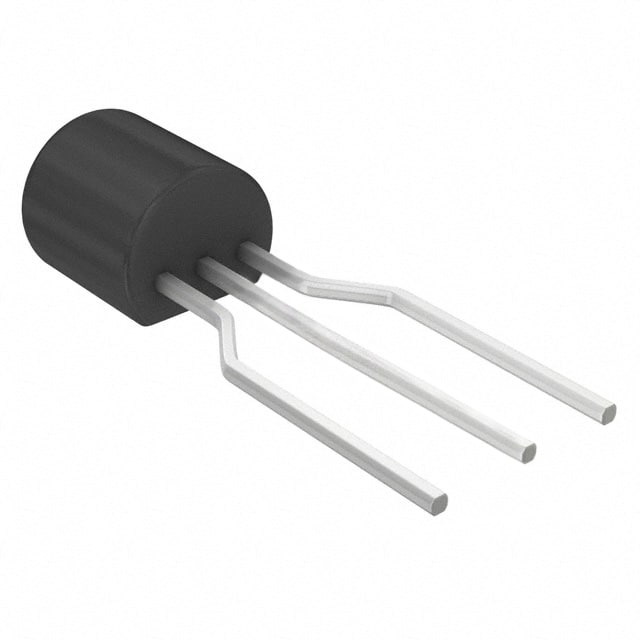
The KSC945GTA from ON Semiconductor is a single NPN bipolar junction transistor (BJT) housed in a TO-92-3 package. This component is designed for through-hole mounting and offers a collector-emitter voltage of up to 50V and a continuous collector current of 150mA.
With a power dissipation rating of 250mW and a transition frequency of 300MHz, the KSC945GTA is suitable for various amplification and switching applications. It exhibits a minimum DC current gain (hFE) of 200 at 1mA and 6V, with a Vce saturation of 300mV maximum at 10mA and 100mA. The operating temperature range is from -55°C to 150°C (TJ).
This transistor is specified with RoHS3 compliance and MSL 1 rating. Its through-hole mounting type and standard TO-92-3 package make it a versatile choice for circuit designs requiring discrete bipolar transistors.
| Qty | Low | High |
|---|---|---|
| 1+ | $0.99 | $0.99 |
Estimated market price range - modelled values for guidance only, not live distributor offers.
The collector-emitter voltage for the KSC945GTA transistor is 50V.
The maximum continuous collector current for the KSC945GTA is 150mA.
The minimum DC current gain (hFE) of the KSC945GTA is 200 at 1mA collector current and 6V collector-emitter voltage.
The operating temperature range for the KSC945GTA transistor is 150°C (TJ).
The KSC945GTA transistor is supplied in a TO-92-3 package.
The KSC945GTA transistor is mounted using the through-hole method.