

| Distributor | Stock | Pricing | MOQ | PKG | Lead Time | Date Code | On Order Quantity | On Order Delivery | |
|---|---|---|---|---|---|---|---|---|---|
|
250 pcs
|
250 pcs | On Request | 1 | On Request | On Request | On Request | On Request | On Request |
| Category | |
| Manufacturer Name | |
| Antenna Type | |
| Current | |
| Data Rate | |
| Frequency | |
| Memory Size | |
| Mounting Type | |
| Operating Temperature | |
| Operating Voltage | |
| Power | |
| Protocol | |
| RF Family | |
| Sensitivity | |
| Serial Interfaces | |
| Tape & Reel | |
| Utilized IC | |
| Voltage |
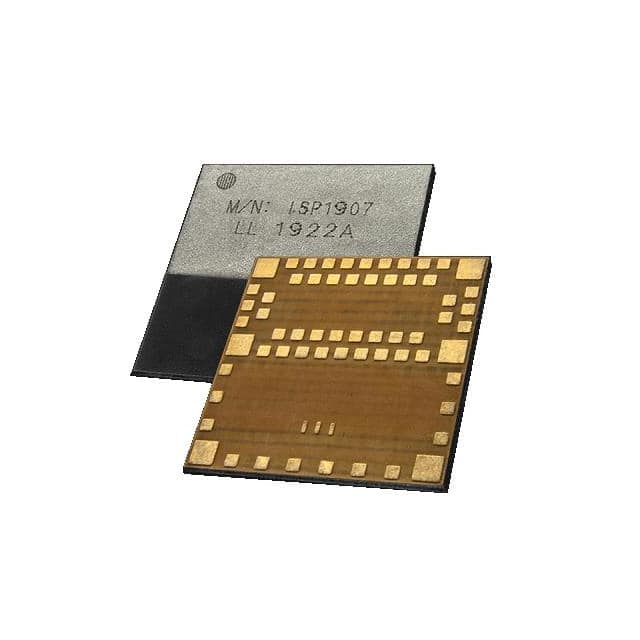
The Insight SIP ISP1907-LL-JT is a Bluetooth 5.1 RF transceiver module designed for long-range and direction-finding applications. This module integrates a 2.4GHz transceiver from the nRF52 Nordic Semi family, featuring a 32-bit ARM Cortex M4 CPU.
Key specifications include 192kB of Flash memory and 24kB of SRAM, supporting multiple protocols such as ANT, Thread, and Zigbee. It operates within a frequency range of 2.36GHz to 2.5GHz with a data rate of up to 2Mbps and a transmit power of 4dBm. The module boasts a sensitivity of -104dBm and consumes 6.1mA of current.
Designed for surface mounting, the ISP1907-LL-JT operates from a single 1.7V to 3.6V supply and has an operating temperature range of -40°C to 85°C. It features integrated antenna, multiple analog and digital I/Os including ADC, SPI, UART, PDM, and I2C. The module is pin-compatible with iSP15, 18 & 19 series.
Applications for this module include connected sensors for medical devices, healthcare, sport, fitness, industrial IoT, connected objects, wearable technology, and home automation.
| Qty | Low | High |
|---|---|---|
| 1+ | $0.99 | $0.99 |
Estimated market price range - modelled values for guidance only, not live distributor offers.
The module supports Bluetooth version 5.1.
It has 192kB of Flash memory and 24kB of SRAM.
The module operates from 1.7V to 3.6V.
The operating temperature range is -40°C to 85°C.
Yes, it features an integrated antenna.
Available interfaces include ADC, GPIO, I²C, SPI, PDM, and UART.