

| Distributor | Stock | Pricing | MOQ | PKG | Lead Time | Date Code | On Order Quantity | On Order Delivery | |
|---|---|---|---|---|---|---|---|---|---|
|
6,893 pcs
|
6893 pcs | On Request | 1 | On Request | On Request | On Request | On Request | On Request |
| Category | |
| Manufacturer Name | |
| Current | |
| Frequency | |
| Gain | |
| Mounting Type | |
| Noise Figure | |
| P1dB | |
| RF Type | |
| Storage Temperature | |
| Supplier Device Package | |
| Tape & Reel | |
| Test Frequency | |
| Voltage |
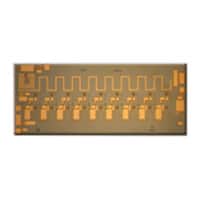
The HMC462 is a GaAs pHEMT MMIC Low Noise Amplifier designed for operation between 2 and 20 GHz. This amplifier provides a typical small signal gain of 15.5 dB and a noise figure of 2.5 dB. It can deliver up to +15.5 dBm of output power at 1 dB compression.
With excellent gain flatness of ±0.3 dB from 8-14 GHz, the HMC462 is suitable for EW, ECM, and radar applications. It requires a single +5V supply at 63 mA and features internally matched 50-ohm input/output for easy integration into multi-chip modules.
The die size is 3.0 x 1.3 x 0.1 mm. Typical applications include test instrumentation, microwave radio and VSAT, military and space, telecom infrastructure, and fiber optics.
| Qty | Low | High |
|---|---|---|
| 1+ | $0.99 | $0.99 |
Estimated market price range - modelled values for guidance only, not live distributor offers.
The HMC462 operates from 2 to 20 GHz.
The typical gain is 15.5 dB from 2-8 GHz, 15 dB from 8-16 GHz, and 14.5 dB from 16-20 GHz.
The typical noise figure is 2.5 dB.
The P1dB is 15.5 dBm from 2-8 GHz, 14.5 dBm from 8-16 GHz, and 13 dBm from 16-20 GHz.
The HMC462 requires a +5V supply at a typical current of 63 mA.
The HMC462 is supplied as a die.