

| Distributor | Stock | Pricing | MOQ | PKG | Lead Time | Date Code | On Order Quantity | On Order Delivery | |
|---|---|---|---|---|---|---|---|---|---|
|
24,240 pcs
|
24240 pcs | On Request | 1 | On Request | On Request | On Request | On Request | On Request | |
|
12 pcs
|
12 pcs | On Request | 1 | On Request | On Request | On Request | On Request | On Request |
| Category | |
| Manufacturer Name | |
| Current | |
| Diode Type | |
| Halogen Free | |
| Mounting Type | |
| Operating Temperature | |
| Storage Temperature | |
| Supplier Device Package | |
| Tape & Reel | |
| Technology | |
| Voltage | |
| Weight |
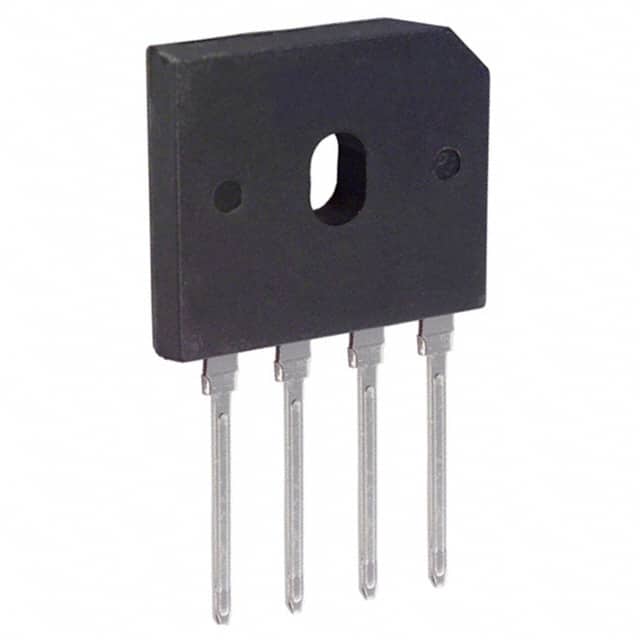
The GBU810 is a single phase glass passivated bridge rectifier from Diodes Incorporated, designed for general purpose AC-DC conversion. It features a peak repetitive reverse voltage of 1000V and an average forward rectified current of 8.0A when mounted on a 50x50x1.6mm copper heatsink at TC=100°C. The forward voltage drop is typically 1.0V at 4.0A per element, and the non-repetitive peak surge current is 200A.
The device is packaged in a GBU 4-SIP through-hole package with tin-plated terminals, suitable for soldering per MIL-STD-202 Method 208. It has a dielectric strength of 1500V RMS and a maximum mounting torque of 5.0 in-lb. The operating and storage temperature range is -55°C to +150°C, with a thermal resistance junction-to-case of 2.2°C/W.
Compliance includes RoHS with exemptions (Glass and High Temperature Solder), MSL Level 1 per J-STD-020C, and lead-free finish. The case material is UL 94V-0 rated molded plastic. This part is ideal for applications requiring high voltage and current handling in a compact through-hole format.
| Qty | Low | High |
|---|---|---|
| 1+ | $2.05 | $2.05 |
| 10+ | $1.10 | $1.10 |
| 100+ | $0.85 | $0.85 |
Estimated market price range - modelled values for guidance only, not live distributor offers.
1000V.
8.0A at TC=100°C with a 50x50x1.6mm copper heatsink.
1.0V typical at 4.0A per element.
GBU 4-SIP through-hole package.
200A for an 8.3ms single half sine-wave.
-55°C to +150°C.
Yes, with exemptions for glass and high temperature solder.