

| Distributor | Stock | Pricing | MOQ | PKG | Lead Time | Date Code | On Order Quantity | On Order Delivery | |
|---|---|---|---|---|---|---|---|---|---|
|
31,791 pcs
|
31791 pcs | On Request | 1 | On Request | On Request | On Request | On Request | On Request |
| Category | |
| Manufacturer Name | |
| Current | |
| DC Current Gain (hFE) (Min) @ Ic, Vce | |
| Frequency | |
| Mounting Type | |
| Power | |
| Resistor | |
| Storage Temperature | |
| Supplier Device Package | |
| Transistor Type | |
| Vce Saturation (Max) @ Ib, Ic | |
| Voltage |
The FJV4113RMTF is a PNP pre-biased bipolar junction transistor (BJT) manufactured by ON Semiconductor. It integrates a 47 kΩ base resistor, which reduces the need for external bias components and simplifies circuit design. This device is intended for low-power switching and amplification applications.
The transistor features a minimum collector-emitter breakdown voltage of 50 V and a maximum collector current of 100 mA. It provides a minimum DC current gain of 68 at 5 mA collector current and 5 V collector-emitter voltage. The collector-emitter saturation voltage is 300 mV maximum at 500 µA base current and 10 mA collector current. The device has a typical transition frequency of 200 MHz.
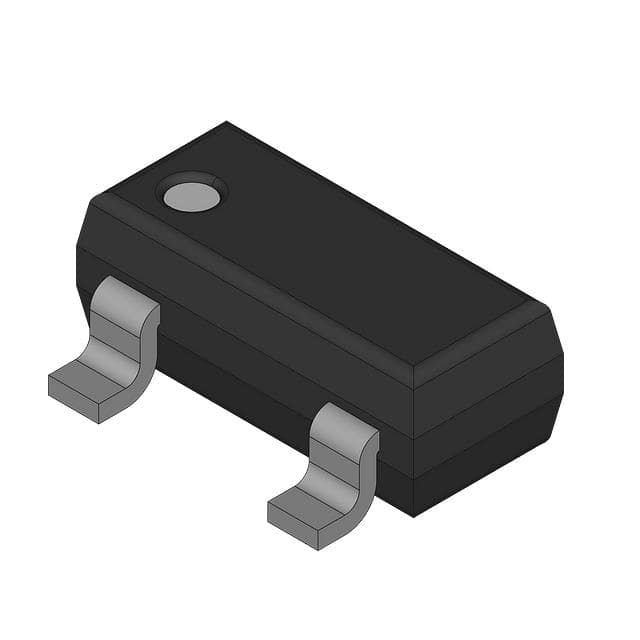
With a maximum power dissipation of 200 mW, the FJV4113RMTF is suitable for compact, low-power circuits. The SOT-23-3 surface-mount package (also available as TO-236-3 or SC-59) is ideal for automated assembly and space-constrained designs. The part is RoHS3 compliant and has an MSL rating of 1 (unlimited).
| Qty | Low | High |
|---|---|---|
| 27,000+ | $0.02 | $0.02 |
Estimated market price range - modelled values for guidance only, not live distributor offers.
The minimum collector-emitter breakdown voltage is 50 V.
The FJV4113RMTF is available in TO-236-3, SC-59, and SOT-23-3 packages. The supplier device package is SOT-23-3.
Yes, it is RoHS3 compliant according to existing data.
The maximum collector current is 100 mA.
The maximum power dissipation is 200 mW.
The built-in base resistor is 47 kΩ (nominal).
The typical transition frequency is 200 MHz.