

| Distributor | Stock | Pricing | MOQ | PKG | Lead Time | Date Code | On Order Quantity | On Order Delivery | |
|---|---|---|---|---|---|---|---|---|---|
|
3,200 pcs
|
3200 pcs | On Request | 1 | On Request | On Request | On Request | On Request | On Request |
| Category | |
| Manufacturer Name | |
| Capacitance @ Vr, F | |
| Current | |
| Halogen Free | |
| Lead Style | |
| Mounting Type | |
| Operating Temperature | |
| Reverse Recovery Time (trr) | |
| Speed | |
| Storage Temperature | |
| Supplier Device Package | |
| Tape & Reel | |
| Technology | |
| Termination Style | |
| Voltage |
The FFSB3065B is a Silicon Carbide (SiC) Schottky diode from ON Semiconductor's EliteSiC family. It is designed for high-efficiency power conversion with a maximum reverse voltage rating of 650V and continuous forward current of 30A at case temperature up to 139°C.
Key electrical characteristics include a typical forward voltage of 1.38V at 30A and 25°C, zero reverse recovery time due to SiC Schottky technology, and a maximum junction temperature of 175°C. The diode offers high surge current capability of 1100A (10 µs pulse at 25°C) and is avalanche rated at 144 mJ.
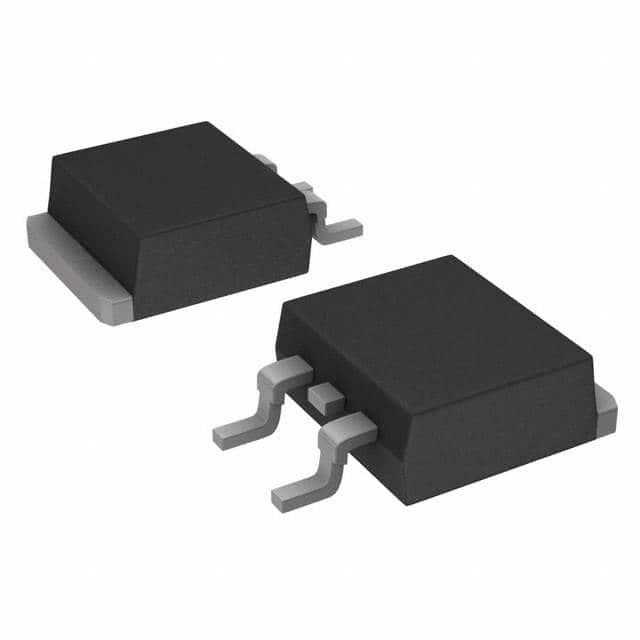
The device is housed in a surface mount D2PAK-2 (TO-263-2L) package with gull wing leads. It is suitable for general purpose applications such as power factor correction, solar inverters, UPS systems, and other power switching circuits. The diode is Pb-free, halogen-free, and RoHS compliant.
| Qty | Low | High |
|---|---|---|
| 1+ | $8.18 | $8.18 |
| 10+ | $5.56 | $5.56 |
| 100+ | $4.07 | $4.07 |
| 500+ | $3.70 | $3.70 |
| 800+ | $3.70 | $3.70 |
Estimated market price range - modelled values for guidance only, not live distributor offers.
650V.
73A at case temperature below 25°C, and 30A at case temperature below 139°C.
1.38V typical, 1.7V maximum at 25°C.
No, it has zero reverse recovery time (0 ns) due to SiC Schottky technology.
Surface mount D2PAK-2 (TO-263-2L) with 2 leads and tab.
1100A for a 10 µs pulse at 25°C, and 120A for an 8.3 ms half-sine pulse at 25°C.
Yes, with a single pulse avalanche energy of 144 mJ.