

| Distributor | Stock | Pricing | MOQ | PKG | Lead Time | Date Code | On Order Quantity | On Order Delivery | |
|---|---|---|---|---|---|---|---|---|---|
|
64 pcs
|
64 pcs | On Request | 1 | On Request | On Request | On Request | On Request | On Request |
| Category | |
| Manufacturer Name | |
| Lead Spacing | |
| Mounting Type | |
| Number of Gates | |
| Number of I | |
| Number of LABs | |
| Number of Logic Elements | |
| Operating Temperature | |
| Supplier Device Package | |
| Supply Voltage | |
| Total RAM Bits | |
| Voltage |
The Intel EPF10K100EQC240-3 is a high-density Field Programmable Gate Array (FPGA) from the FLEX 10K family, designed for System-on-a-Programmable-Chip (SOPC) integration. This device offers 4,992 logic elements and 624 Logic Array Blocks (LABs), providing substantial programmable logic resources.
Key electrical specifications include 49,152 total RAM bits and 189 I/O pins, enabling robust interfacing with external systems. It operates within a supply voltage range of 2.375V to 2.625V and has an operating temperature range of 0°C to 70°C (TA).
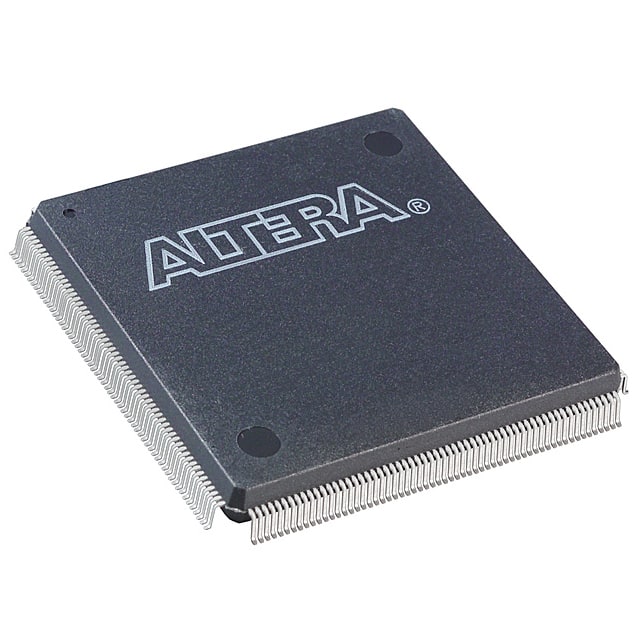
The EPF10K100EQC240-3 is housed in a 240-pin Quad Flat Package (QFP), specifically a 240-BFQFP, and supports surface mount technology. The device also includes features like JTAG boundary-scan circuitry and support for PCI compliance.
This FPGA is suitable for applications in telecommunications, industrial control, consumer electronics, automotive, and medical devices, offering flexibility and performance for complex digital designs.
The EPF10K100EQC240-3 FPGA has 4,992 logic elements.
The EPF10K100EQC240-3 has 189 I/O pins.
The EPF10K100EQC240-3 operates within a supply voltage range of 2.375V to 2.625V.
The EPF10K100EQC240-3 is supplied in a 240-pin Quad Flat Package (QFP), specifically a 240-BFQFP.
The EPF10K100EQC240-3 operates within a temperature range of 0°C to 70°C (TA).
The EPF10K100EQC240-3 features 49,152 total RAM bits.
Yes, the EPF10K100EQC240-3 includes built-in Joint Test Action Group (JTAG) boundary-scan test circuitry compliant with IEEE Std. 1149.1-1990.