Ready to onboard?
Are you ready to join DistyParts and
grow your business?


| Distributor | Stock | Pricing | MOQ | PKG | Lead Time | Date Code | On Order Quantity | On Order Delivery | |
|---|---|---|---|---|---|---|---|---|---|
|
52,020 pcs
|
52020 pcs | On Request | 1 | On Request | On Request | On Request | On Request | On Request |
| Category | |
| Manufacturer Name | |
| AEC Qualified | |
| Automotive Grade | |
| Case Code | |
| Case Material | |
| Collector-Base Voltage (VCBO) | |
| Current | |
| DC Current Gain (hFE) (Min) @ Ic, Vce | |
| Emitter-Base Voltage (VEBO) | |
| Frequency | |
| Halogen Free | |
| Mounting Type | |
| Operating Temperature | |
| Peak Pulse Current | |
| Power | |
| Power Dissipation (Maximum @ Note 6) | |
| Storage Temperature | |
| Supplier Device Package | |
| Tape & Reel | |
| Terminal Finish | |
| Termination Finish | |
| Thermal Resistance Junction to Ambient (@ Note 6) | |
| Thermal Resistance, Junction to Ambient (Note 5) | |
| Transistor Type | |
| UL Flammability Rating | |
| Vce Saturation (Max) @ Ib, Ic | |
| Voltage | |
| Weight |
The DXTN58100CFDB-7 is a 100V NPN low saturation transistor from Diodes Incorporated, designed for high-efficiency switching applications. It offers a maximum collector current of 4A continuous and 6A peak, with a DC current gain (hFE) of 180 minimum at 500mA and 2V.
The transistor features a low Vce saturation voltage of 260mV maximum at 4A collector current, reducing power losses. With a transition frequency of 150MHz, it is suitable for DC-DC converters, charging circuits, motor control, and power switches.
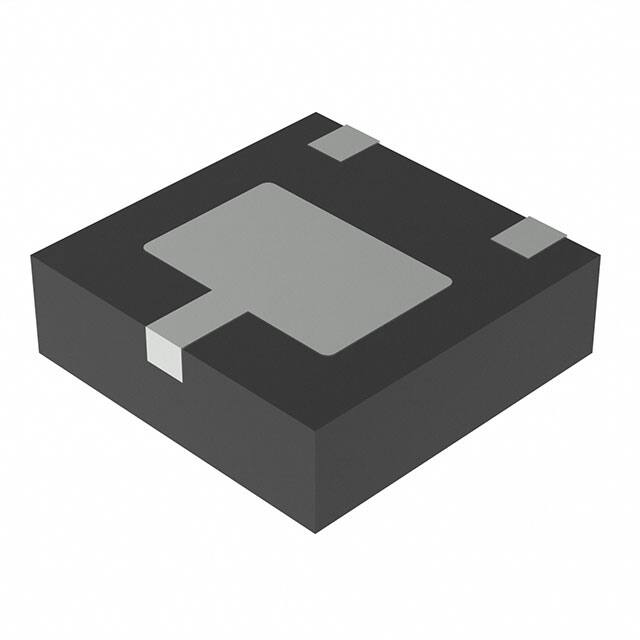
The device is housed in a compact U-DFN2020-3 (Type B) surface-mount package with an exposed pad for improved thermal performance. It has a maximum power dissipation of 690mW (Note 5) or 1.25W (Note 6), with thermal resistance of 180°C/W (Note 5) and 100°C/W (Note 6). The operating junction temperature range is -55°C to 150°C.
The package is lead-free, RoHS compliant, and halogen- and antimony-free (Green). It has a UL flammability rating of 94V-0 and moisture sensitivity level 1. The termination finish is NiPdAu, solderable per MIL-STD-202.
| Qty | Low | High |
|---|---|---|
| 1+ | $0.99 | $0.99 |
| 10+ | $0.60 | $0.60 |
| 100+ | $0.45 | $0.45 |
| 3,000+ | $0.45 | $0.45 |
Estimated market price range - modelled values for guidance only, not live distributor offers.
100V.
U-DFN2020-3 (Type B) surface-mount package with exposed pad.
-55°C to 150°C junction temperature.
Yes, it is fully RoHS compliant and lead-free.
Minimum 180 at 500mA collector current and 2V Vce.
150 MHz.
690mW (Note 5) or 1.25W (Note 6) depending on conditions.